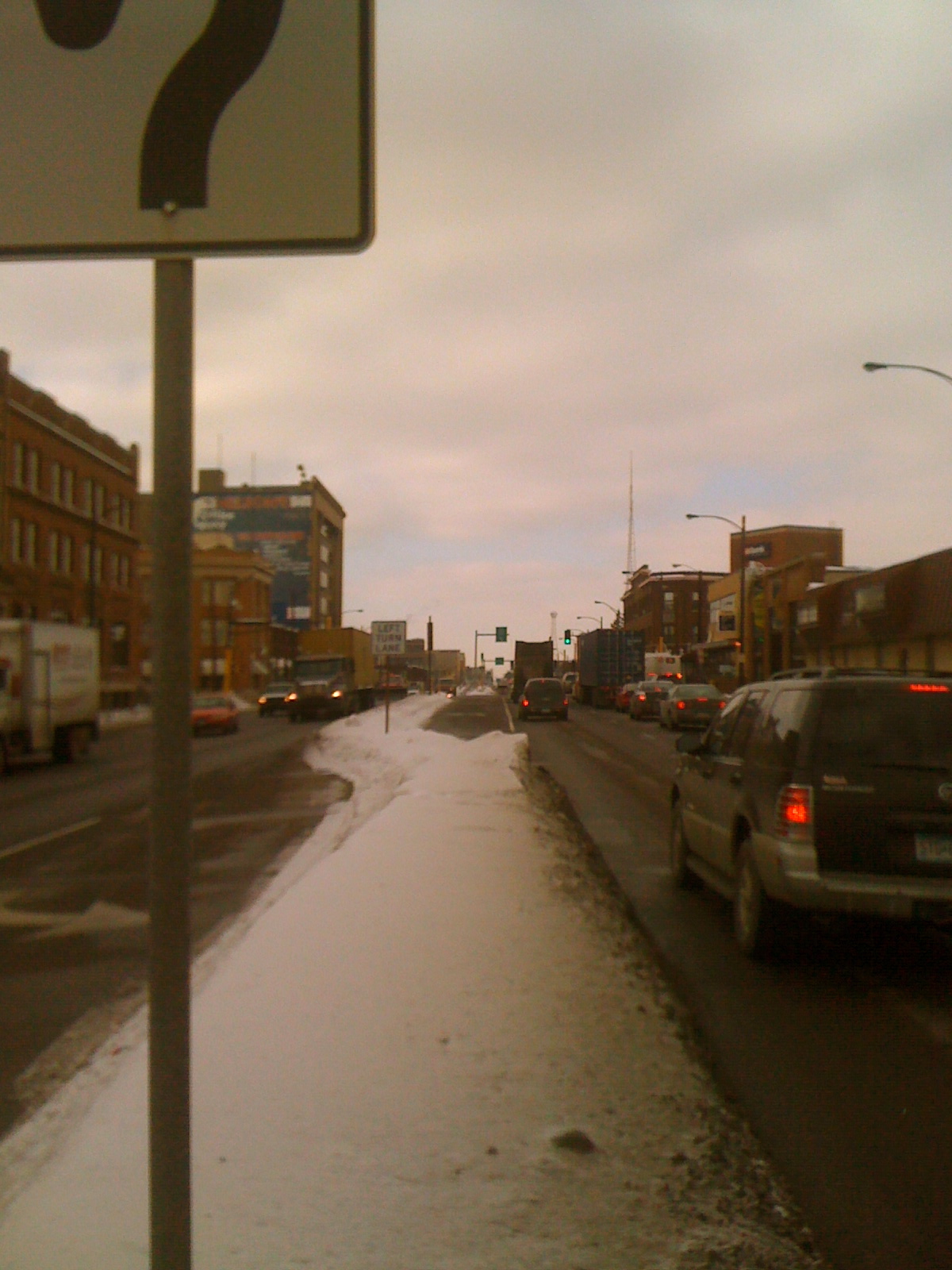
The Central Corridor light rail project has taken both a step toward full funding and lost legal ground. In the last week of January, a federal judge ruled that the project’s ‘Final Environmental Impact Statement’ (FEIS) did not adequately assess the potential loss in business revenue during construction. One week later, the ‘full funding grant agreement’ was sent to the U.S. Continue Reading
A billion public transit dollars for a 100 million dollar road construction project. No sidewalk and a suicidal pedestrian crossing. Reduced local and express bus service. Small, local, independent businesses dropping like flies while the big box, fast food, suburban-style, industrial office park, parking lot franchises remain unscathed. Environment justice award? Continue Reading
Walk a mile in Minnesota winter? Carrying a baby or groceries? No problem, thought the Central Corridor planners. Then the Stops for Us coalition gave a voice to the folks who live and walk or take the bus home along University Avenue. Continue Reading
As planning begins along the Central Corridor, Model Cities wants to get a head start. Their latest project, which is in the first developing stages, is a mixed-use project that will include affordable housing along Central Corridor on University Avenue. According to the CEO of Model Cities Dr. Beverley Hawkins, they are looking at addresses 773-785 on University Avenue between Lexington Avenue and Dale Street, which are currently vacant. So far they have site control of two of these sites, 773 and 785, which they have acquired through their own funds. Model Cities is a Community Development Corporation (CDC) based in St. Continue Reading
On November 17, the Community Engagement Team for a new $5 million HUD grant (see sidebar) held an information session about the grant for the community that was less than informative.On October 14, HUD awarded the Metropolitan Council a $5 million grant, which is part of a nationwide $100 million HUD Sustainable Communities Regional Planning Grant to create sustainable communities by integrating affordable housing, the environment, and transportation.According to the Met Council press release, the grant is to be used to create “optimal development” along five major corridors: Southwest Light Rail Transit, Bottineau, Cedar Avenue Bus Rapid Transit, Northstar Commuter Rail and the Gateway Corridor. In the press release the Met Council said it will look to the current planning around the Central Corridor as an example, focusing on energy efficiency and affordable housing.The information session was full, but mainly attended by organizations that were already involved with the transitways, including Mark Vanderschaaf from the Metropolitan Council and very few community members. Russ Adams from the Alliance for Metropolitan Stability said they hope to hold meetings at more convenient times in the future (the meeting was at 1:30 p.m.), so more people would be able to attend.The session began with a panel from the three organizations that make up the Community Engagement Team (CET): Russ Adams with Alliance for Metropolitan Stability (AMS); Margaret Kaplan with the University of Minnesota’s Minnesota Center for Neighborhood Organizing (MCNO); and Repa Mekha with NEXUS Community Partners. They began by discussing the basics of the grant and how it is to be used to build sustainable communities along the five major corridors, which was awarded to the Metropolitan Council to promote sustainable communities along the 5 major corridors. They discussed how, while they have no decision-making power, their role is to be the voice of the community for the policy board of the project, which is headed by the Metropolitan Council. Continue Reading
Five Metro Transit police officers greeted attendees of a federal court hearing Friday afternoon in downtown St. Paul. The hearing was to determine whether or not a lawsuit filed by the St. Paul Branch of the NAACP, the Aurora St. Anthony Community Development Corporation, Pilgrim Baptist Church, and a list of neighborhood businesses and residents, will halt the Central Corridor project and force the Met Council and the Federal Transit Administration to comply with requirements of the National Environmental Policy Act (NEPA).Plaintiff attorney Thomas DeVincke of the Minneapolis law firm Bonner and Borhart argued that the analysis NEPA requires is not contained in the massive project record prepared by the Met Council and approved by the FTA. Continue Reading
“Build right, not on the backs of small businesses,” is a motto of the University Avenue Business Association (UABA), according to director Linda Winsor. On October 28, UABA and the Asian Economic Development Association (AEDA) brought small businesses together for a resource workshop offering free services such as business consulting, legal services, marketing assistance. “We are neither pro or anti Light Rail-we realize it’s coming,” Linda Winsor, the executive director of UABA said. “We just want to make sure small businesses along the avenue get the help needed to survive construction.”University Avenue business owners came at different times throughout the day to have consultations about concerns or legal questions they had.Rob Routhieaux, an associate professor at Hamline University and a working member of UABA, gave two short presentations throughout the day.Routhieaux said about 60 people showed up for the presentation, which he characterized as “a great turn-out.””We didn’t have enough chairs, it was standing room only,” said Linda Winsor, the executive director of UABA.The services provided by UABA are an on-going collaborative effort by concerned business owners as well as professors and students who give their time to help University Avenue businesses the information they need.UABA’s Business Information Center is made up by university associates and their M.B.A. students from Hamline University School of Business and Macalester College to give private consultations with business owners to help strategize surviving the construction.Though the start of construction is a year or more off for some businesses, there is a lot of preparation to do. Stories such as Lessons learned from Lower Town in St. Continue Reading