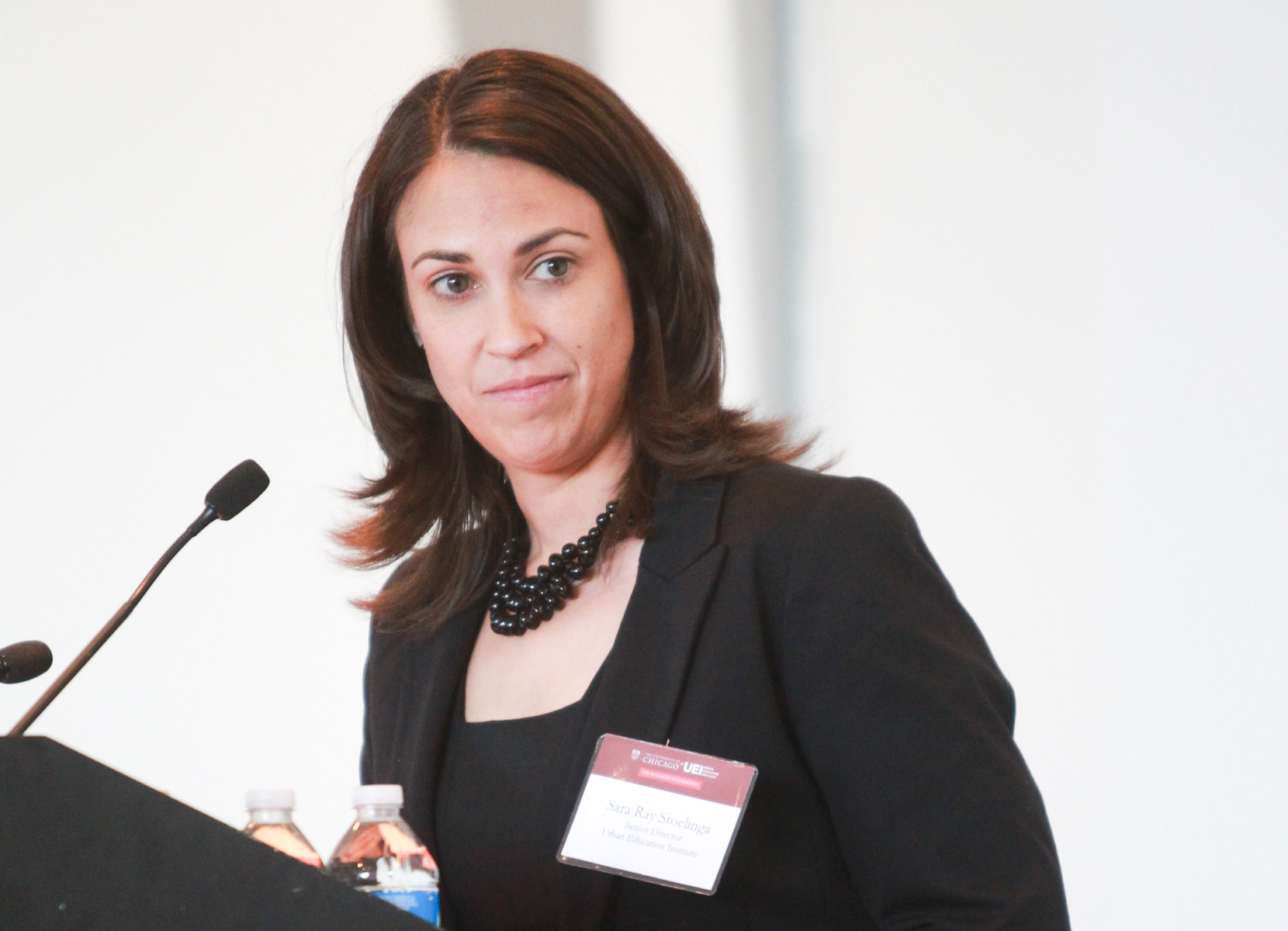
On a lovely spring evening over 100 people stayed inside to listen to five educations experts talk about education policy in the Twin Cities schools. Participants did not give up the great weather for a dry policy wonk debate. Instead, they were treated to a spirited and civil panel discussion sponsored by the McKnight Foundation and the Urban Education Institute (UEI) at the University of Chicago.
Ask any educator what the biggest problems facing Minneapolis and St. Paul schools are, and the achievement gap will be among the top three answers. As a parent, former teacher, activist, school board member and advocate for children, Pam Costain has both a realistic grasp of the difficulty of closing the achievement gap and a commitment to keep trying.The achievement gap, defined simply, is the gap in test scores between white students and students of color. It’s a gap that persists at all grade levels, in both Minneapolis and St. Paul, and throughout the state of Minnesota. Continue Reading
According to a 2009 report to the State of Minnesota, only two of five American Indian high school students in Minnesota graduate high school within four years, as compared to four out of five white students. That’s just one of the statistics on the American Indian student achievement gap, which was the focus of a November 15 conference, sponsored by the Minnesota Humanities Center. In broad terms, the achievement gap is defined as significant disparities between groups of students. The MHC invited parents, community members, teachers, and school administrators to Mounds Park American Indian Magnet school in St. Paul to review the achievement data of American Indian students, especially as described in the report.The report was compiled by the Advisory Task Force on Minnesota American Indian Tribes and Communities and K-12 Standards Based Reform. Continue Reading
Putting students first is among the most important things to be done if ever the Black-White student achievement gap is to be closed, several education professionals and advocates agreed at a re
Minnesota’s Black-White achievement gap extends well beyond the state’s high schools into its post-secondary schools, a 2010 report shows. The combined graduation rates after six years of college at seven Minnesota State Colleges and Universities (MnSCU) for Black students who entered as freshmen in 2000, 2001 and 2002 was on average 22 percent behind their White peers. The report “opens up the door for a ton of questions,” says Minnesota Minority Education Partnership (MMEP) Executive Director Carlos Mariani. Coverage of issues of race and race relations, cultural diversity and immigrant health issues is funded in part by a grant from the F.R. Bigelow Foundation. Among all seven institutions, less than 40 percent of Black students graduated after six years: St. Cloud State University (39 percent), Winona State (35 percent), Minnesota State-Mankato (31 percent), Bemidji State (23 percent), Southwest Minnesota State (20 percent), Minnesota State-Moorhead (nine percent), and Metropolitan State University (zero percent, having only 11 entering Black freshmen over the three-year period, none of whom graduated after six years).Meanwhile, the combined graduation rates for all students at the seven MnSCU schools over the same three six-year periods (2000-2006, 2001-2007, 2002-2008) are: St. Continue Reading
Dr. Roy I. Jones, executive director of Clemson University’s Call Me MISTER (Mentors Instructing Students Toward Effective Role Models)) will keynote the St.
When you look at the numbers, it couldn’t be more clear: The Latino population in Minnesota is growing, particularly the population of young people. And yet, Latino students, like African American and American Indian students, are failing in our schools. This is nothing new. This has been going on a long time. The question, raised by the Minnesota Humanities Center and the Chicano Latino Affairs Council, is what do we do about it?
Though the achievement gap persists as an ongoing problem in Minnesota schools, some kindergarten teachers are beating the odds. Minneapolis Public Schools’ (MPS) “Beat the Odds” teachers were singled out for their results with minority students. The teachers were identified using a value-added analysis by MPS’s research, evaluation and assessment department. The department has a number of videos available that show the successful teachers at work.”We try to find the teachers that impacted students test scores the most,” said David Heistad, director of research, evaluation and assessment for MPS. In the case of kindergarteners, this means pre-reading skills- being able to identify letters, sounds, and ends of words, and being able to comprehend a story when it is told to them. Heistad said that some of the methods that seem to work include Peer Assisted Learning (PAL), which involves students teaching each other in a non judgmental environment, or direct instruction with specific feedback in small groups. He also said successful teachers incorporated cooperative groups, journaling, and phonics instruction. “There isn’t any magic curriculum that will make every child succeed,” said Marie Olson, a kindergarten teacher at Lyndale Community School, one of the teachers identified as achieving impressive outcomes with minority students. She said it was important to differentiate the needs of each student, and zone in on what will work. Olson conducts mini-assessments throughout the year to gauge what needs to be met in her classroom. “The standardized [tests] give good info,” she said, “but the smaller in-between assessments can be useful throughout the year.” Olson said the most important thing is “when kids know you care about them.” She gave an example of an Ethiopian student in her classroom that just moved to Minnesota and was struggling with adjusting and with language. Because Olson was able to develop a bond with the student, the girl was able to make leaps and bounds in just a few months. “She really has shot for the stars,” Olson said. Olson has been teaching in Minneapolis since 1989, and says that there is no one “method” that she uses, but rather has learned by thinking on her feet, and teaching beyond the curriculum. She often teaches above and beyond what kindergarteners are required to learn, and says that she focuses on instilling in the students a love of learning. Olson said that while her teaching is intuitive, the school district can benefit from a supportive environment where teachers who have success can teach others. “You don’t want to have to re-invent the wheel,” she said. Continue Reading
One more meeting about the achievement gap: can there be anything new to say? Surprisingly, it seems that there is. About 70 people gathered May 21 at University Lutheran Church of Hope heard Dr. David Heistad, director of research, evaluation and assessment for MPS, describe the current achievement gap and point toward success at both ends of the spectrum – graduation rates and kindergarten readiness. He also identified two specific factors that have the highest correlation with increased student achievement. The racial achievement gap continues, not only in Minneapolis but statewide. Minnesota’s fourth-grade students have the nation’s second-worst reading gap between black and white students. Continue Reading
We know the achievement gap exists. We know the gap in reading and math test scores between white students and students of color exists across the nation. But it is especially pronounced in Minnesota. But when we’re talking about numbers, it’s also important to remember those numbers represent children. Longtime Minneapolis educator Eleanor Coleman put it bluntly: “We’ve got to remember we’re talking about children, all children,” when we talk about the achievement gap, she said. The numbers are indisputable. Continue Reading