South St. Anthony Park will once again have its own full-service coffee shop and café. WORKHORSE COFFEE BAR (yes, it’s all caps) plans to open later this fall at 2399 University Ave. in the space that formerly housed the Edge Coffee Shop.
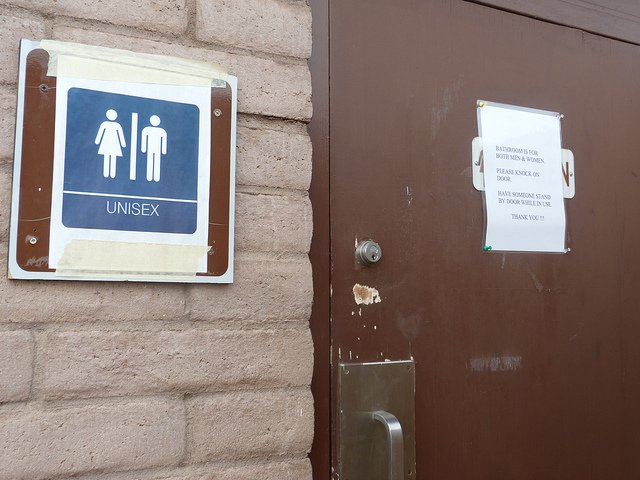
The Minneapolis City Council unanimously passed a resolution and an ordinance change on Friday allowing businesses to have gender neutral, single-use restroom facilities. The issue was raised by the Minneapolis Transgender Issues Work Group.
How much would you pay for a pork chop that was two percent leaner? Would you eat such a pork chop if nanoscale minerals were mixed into the hog feed to achieve that two percent reduction? Such questions are before the Food and Drug Administration (FDA) as it considers what to advise the animal feed and mineral supplement industry about their efforts to incorporate atomic- to molecular-sized materials into feed. Continue Reading
At the end of the year, the city-owned Upper Harbor Terminal will stop operating, ending an era that began when the site opened in 1968. The 48-acre industrial stretch on the west side of the Mississippi River between the Lowry and Camden bridges is destined for transformation in the coming years, but just what shape it will take remains up for discussion.
“Farmers often work twelve-hour days,” Yao Yang explained. Having water available near the field is a big deal. That’s often not the case on rented fields, but it’s an important part of the Hmong American Farm. So are the simple washing sheds where they can prepare produce for market, and the cooler where produce can be stored until it’s picked up for delivery. Continue Reading
The Seward Café, which turns 40 years old some time this year, is a study in contradictions. Although it’s known for its longevity, laying claim to being both the oldest collectively-managed business in the Twin Cities and the oldest collectively-managed restaurant/-café in the U.S., its actual collectives seem to turn over completely about every seven years. Although the café has never been totally vegetarian (the principle is even enshrined in its charter), it has always remained a favorite among vegans and vegetarians. This is probably due to its great range of vegan baked goods and its adherence to an ethos of care with its veg customers by assuring careful separation in the kitchen and full disclosure of ingredients. And further, although it looks small and scruffy and like anything but a gourmet haven, some of its food items are nearly legendary in their greatness. And its amazing survival attests to its success with the public.
An antiquated Minneapolis code relating to the service industry forces many businesses to have gendered restrooms, but a policy change passed by a city committee could change that.At the Health, Environment, and Community Engagement Committee meeting on Monday morning, community members voiced their support for change to city code that would allow businesses to make their facilities more accessible for transgender customers.Tom DeGree, owner of Wilde Roast Cafe and Matties on Main, testified about the challenges his business has faced as it has expanded.DeGree noted that ten years ago when he and his partner opened Wilde Roast Cafe, a LGBT coffee shop in northeast Minneapolis, the business was able to have two nongender bathrooms.“A lot of the transgender community found us as a safe place, and from an economic stance, it’s best to have people have a safe place,” he said.But as business grew and they opened Wilde Roast in a new location on the riverfront, the business bumped up against the city code.The new building “had two predetermined bathrooms. A lot of people from the transgender community didn’t feel as comfortable and voiced their concerns.”When DeGree opened Mattie’s on Main earlier this year, they decided to buck the city code.“We were told by the city that we had to have very specific bathrooms that had male and female on them,” he said. But the business decided to go ahead with gender neutral bathrooms. “When we opened up and went forward with business in May, we just did it.”Council member Cam Gordon quipped, “I don’t think anybody [from the city] is going to come after you.”The proposed city changes would mean non-gendered, single-user restrooms can be put in place of gendered facilities for small businesses.Many testifiers noted that making restrooms trans-friendly actually makes them friendlier for just about everyone.Dylan Flunker, a transgender parent of a 3 year old, noted, “Before I was able to medically transition, I had a lot of uneasy bathroom experiences.”“When using the appropriate bathroom for your gender, people would say, ‘What are you doing?’” Flunker said it was “a very uneasy 3-4 year period of my life where I did not use public restrooms.”Now, as a parent with a 3 year old, Flunker notes that single use, gender neutral facilities are great for parents.“When 3 year old has to go, she has to go and single stall bathrooms are the easiest for us to access.”Claire, male-to-female transgender woman, relayed her experiences.“With obvious issues of me being transgender and using gender specific bathrooms… I have been accosted and threatened in male bathrooms, and questioned and peaked on in female bathrooms. Technically, I’m not allowed in anybody’s bathrooms.”Claire noted that many of Minneapolis’ suburbs allow for gender neutral restrooms. “I think it’s time Minneapolis caught up with the suburbs and do what needs to be done.”She also noted that she has three children with disabilities and one is a teenager. That makes it difficult to use gendered facilities.The proposed changes passed the committee unanimously. They were proposed by City Council member Andrew Johnson of the 12th Ward. He’d been working on the issue accessible restrooms before he ran for office.Johnson said, “It’s a great ordinance…. Continue Reading
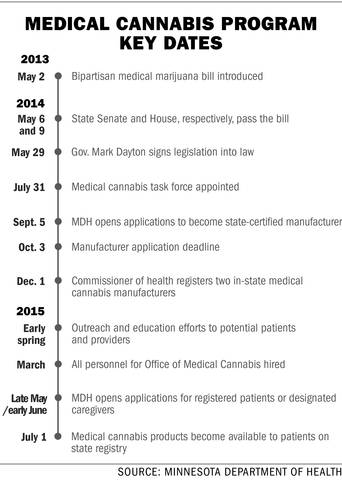
Minnesota advanced in its plan for making medical marijuana available for patients next year as it opened up applications Friday for potential manufacturers of the drug.
Money is not speech. Corporations are not persons. Most of us intuitively understand that. The Supreme Court clearly does not. In Citizens United v. FEC, it ruled that corporations have a First Amendment right to expend unlimited amounts of money to influence elections. More recently, in McCutcheon v. FEC they struck down the overall caps on how much money wealthy individuals can contribute directly to campaigns and to party committees. The Supreme Court’s decisions are wrong and they deserve to be overruled with a constitutional amendment to restore the First Amendment to its rightful place protecting American democracy, instead of as a tool to suppress speech rather than enhance it. Continue Reading