One year after Rock Star Supply Co. set up shop at the southwest corner of Raymond and University avenues, the tutoring and writing development center that offers free tutoring and homework help to low-income students ages 6 to 18, has adopted a new name and expanded programming.
A recent article republished on Twin Cities Daily Planet, but originally published in Insight News, (click here for the article) highlights the fact our North Minneapolis schools need 150 tutors for math and literacy. Continue Reading
The first 6 months of the year I spent time every month on the Fond du Lac reservation – specifically at the tribal center in Cloquet. There’s a library in the tribal center – with computers and good broadband. And once I month I was in the building providing some kind of Internet/computer training. Turns out FdL is top of the class when compared to other tribal libraries. Continue Reading
Preschools and elementary schools across the Twin Cities, most of them located in north Minneapolis, have an immediate need for more than 150 full- and part-time literacy tutors and math tutors for the 2014-15 school year.
Like moths to a flame, Double Dutch is the perfect sport for attracting kids and keeping them moving and motivated throughout the summer.Parents, friends, community members and double dutch enthusiasts packed into the Jimmy Lee Rec Center for the Third Annual Jump Jam Double Dutch Challenge on Aug. 16. Event-goers enjoyed a family resource fair and watched this year’s lineup of Double Dutch teams square off against each other. The event capped off a ten-week fitness program centered around Double Dutch that is sponsored through a partnership between Saint Paul YWCA, Health Partners and the City of Saint Paul.“The program also offers a healthy eating and wellness component, including cooking classes,” said School Success Manager at YWCA Saint Paul Tara Munroe. “The participants come from all different backgrounds and many are new to Double Dutch. Continue Reading
A new “leader letter” from Minneapolis Public Schools Superintendent Bernadeia Johnson’s office landed in my inbox recently. Let’s just say I was intrigued by its contents. Continue Reading
Four Minnesota schools were recently placed on the annual 2014 CampusPride top-50 list of LGBT-friendly colleges and universities. Augsburg College, Macalester College, and both University of Minnesota campuses in Duluth and the Twin Cities, were all ranked as 5-star schools. Schools listed are recognized for their efforts to improve the campus environment for students, particularly in terms of academics and social safety. Augsburg College provides advising and advocacy for students who identify as LGBTQ, such as opportunities for student leadership, and a handful of all-gender bathrooms, amongst other work. “We’re grateful for this type of recognition, but a lot of credit belongs to our students for leading boldly…individually and as groups,” said Stephanie Weiss, a spokesperson for Augsburg College. Continue Reading
The Rev. Dr. William J. Barber II – whose “Moral Mondays” campaign has spread from North Carolina to other states – lead a March for Equity on Aug. 16.
St. Paul Public Schools (SPPS) may follow in the footsteps of Minneapolis and Edina in changing their high school start times to be later. University of Minnesota researcher Dr. Kyla Wahlstrom’s report: “Examining the Impact of Later High School Start Times on the Health and Academic Performance of High School Students: A Multi-Site Study” was released and reported on in late 2013 and has provided the basis for SPPS’ proposed change.The proposal for SPPS would start elementary schools at 7:30 a.m. and begin middle and high schools classes at 8:30 a.m. Dr. Wahlstrom’s report contributes many strongly proven academic and health-related benefits to shifting the start times. The study followed multiple, diverse school districts that have implemented changes in start times including Edina and Minneapolis public school districts as well as schools in Colorado and Wyoming. (The study includes over 12,000 students surveyed on all of the following figures and data)The health-related benefits of a start time change are numerous. Continue Reading
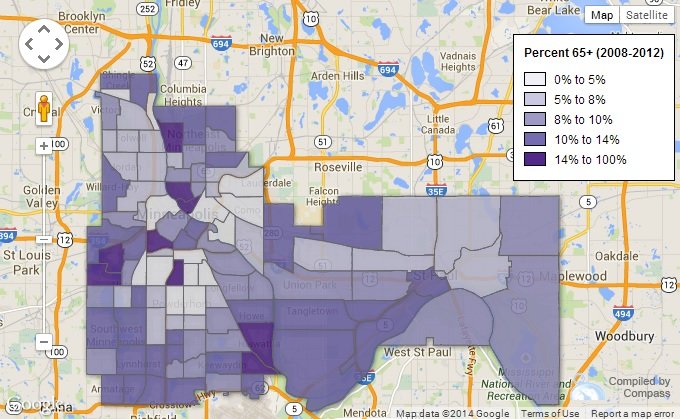
Minnesota Compass, funded through the Amherst H. Wilder Foundation, released an interactive map this week using the most recent census data for Minneapolis and St. Paul. The data shows distinct boundaries in the sister cities, separating neighborhoods based on age, ethnicity, income, education and poverty levels.Most interestingly, when compared side by side, many of the maps reflect inverse patterns that reinforce well-known disparities for communities of color and immigrant communities, as well as distinct segregated boundaries in the metro area.Editor’s note: If you wish to view the maps more closely, follow the above link to Minnesota Compass’ website to look at the interactive map.“The maps reveal some very interesting residential patterns,” said Dr. Craig Helmstetter, Wilder Research senior research manager and project manager of Minnesota Compass in a press release. “For example, did you know that the median household income of Minneapolis’ neighboring North Loop and Near North neighborhoods differ by about $70,000? Or that 30 percent of those living in Saint Paul’s Thomas-Dale neighborhood were born outside of the U.S., compared with only 7 percent right next door in the Como neighborhood?”Each map profile provides for all 87 Minneapolis neighborhoods, 11 Minneapolis communities, and 17 neighborhoods in St. Continue Reading