OUR STORIES | Willie Walton: “He didn’t deserve to die like a dog”

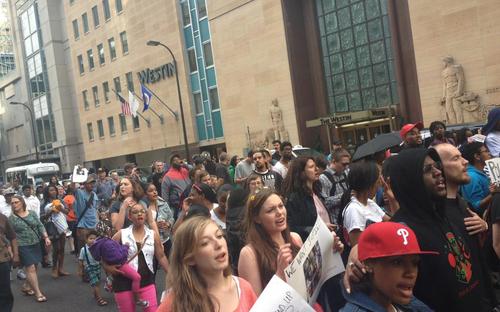
Terrance Franklin’s uncle spoke to Twin Cities Daily Planet Community Engagement Editor Lolla Mohammed Nur while marching through downtown Minneapolis at the Justice for Terrance rally on May 31. Willie Walton, along with Franklin’s father, other family members and supporters, is demanding that Minneapolis police release details about the May 10 shooting that led to Franklin’s death.”We want those Minneapolis cops that killed Terrance, that slaughtered him in the basement, we want them brought to justice,” he said. “Terrance is unarmed. He’s not known for carrying a gun, so why did they slaughter him? He’s not a known criminal. Continue Reading
OUR STORIES | Demetrius H’ro: Terrance Franklin shooting is about systematic racism and “effeminating black men”

Demetrius H’ro is a local spoken word artist who marched at the Justice for Terrance rally on May 31. Terrance Franklin was a 22-year-old who was shot and killed by Minneapolis police on May 10.H’ro attended the rally because he wants to help “start a movement” against institutionalized racism and police brutality, especially toward black men, he said.”I’m in a system that’s trying to effeminate me as a black man and take away my inner power. You notice it in subtle ways that you deal with police, or maybe a job interview,” he explained. “The murder of Terrance [Franklin] is just another part underneath that entire umbrella called ‘racism,’ which is raining down on all of us people of color.”H’ro added, “It’s a part of a problem that’s affecting me and other people of my skin color and anyone that is a victim of systematic racism.” He ends with a powerful message to Minneapolis police and other authorities he sees as hiding behind institutional racism.Related stories:• Protesters demand justice for Terrance Franklin, police prosecution• OUR STORIES | Willie Walton: “He didn’t deserve to die like a dog.”• OUR STORIES | Taharra Patterson: Terrance Franklin “could have been my child”Reporting for this article supported in part by Bush Foundation. Continue Reading

COMMUNITY VOICES | Terrance Franklin shooting is about systematic racism

Demetrius H’ro is a local spoken word artist who marched at the Justice for Terrance rally on May 31. Terrance Franklin was a 22-year-old who was shot and killed by Minneapolis police on May 10.H’ro attended the rally because he wants to “start a movement” against institutionalized racism and police brutality, especially toward black men, he said.”I’m in a system that’s trying to effeminate me as a black man and take away my inner power. You notice it in subtle ways that you deal with police, or maybe a job interview,” he explained. “The murder of Terrance [Franklin] is just another part underneath that entire umbrella called ‘racism,’ which is raining down on all of us people of color.”H’ro added, “It’s a part of a problem that’s affecting me and other people of my skin color and anyone that is a victim of systematic racism.” He ends with a powerful message to Minneapolis police and other authorities he sees as hiding behind institutional racism.For the full story about the rally, read Lolla Mohammed Nur’s story, “Protesters demand justice for Terrance Franklin, police prosecution.” Continue Reading

Protesters demand justice for Terrance Franklin, police prosecution

Loud chants of “No justice no peace!” and “Prosecute the police!” reverberated across Nicollet Mall as hundreds marched through downtown Minneapolis last Friday evening. About 250 protesters gathered in a rally organized by family and friends of 22-year-old Terrance “Mookie” Franklin, who was shot and killed by Minneapolis police in the basement of a home on May 10.“We gonna fight, we gonna stand for Terrance. They’re gonna see our faces until we get justice, because we want to know what happened to Terrance,” said Walter Franklin, Terrance’s father, in front of a cheering crowd.The family is demanding an independent investigation into the shooting, and for the police to be prosecuted. Members of the family said they doubt the Minneapolis Police Department’s version of the incident. MPD has not released many details about the shooting, but police have said Franklin fled and resisted arrest after he was identified as a burglary suspect. Continue Reading

REPORTER’S NOTEBOOK | Teacher’s headlock of Somali student – is this about race?

The appearance of two Youtube videos showing a teacher apparently holding a Somali student in a headlock sparked outrage in the Somali American community. The incident took place at Champlin Park High School. The first video shows a verbal altercation between two students escalating to a physical attack, and the teacher intervening; the second video shows the teacher apparently grabbing the Somali student by throat, putting him in a headlock and holding him there. The family has identified the Somali student as 14-year-old Camaar Abdul-Kadir.Watching the videos, it is hard to ignore that a Somali student is on the receiving end of physical attacks from a white student and then from a white teacher. On the other hand, the videos do not provide a complete story. Many questions remain unanswered: What happened? Continue Reading

OUR STORIES | Sheeko: Documenting Somali youth diaspora stories

Fartun Abdi is passionate about preserving her generation’s oral histories. Abdi is a member of and researcher with the Sheeko Project, which started in 2011 to document and digitize oral stories of Somali diaspora youth. The project is a collaboration between the University of Minnesota’s Immigration History Research Center (IHRC), campus faculty, staff, and students.“What does it mean to be Somali? Somali American? Somali diasporan? Continue Reading

OUR STORIES | A DREAMer’s story: from undocumented immigrant to advocate

Daniel Perez is a young Mexican American graduate student who was undocumented until he was granted a work visa through DACA. In this video he recounts some of the struggles of being an undocumented immigrant, and how he is giving back to his family and community after becoming a documented immigrant. He also breaks stereotypes about undocumented immigrants and discusses why he supports immigration reform. Continue Reading

OUR STORIES | Young Ethiopian American founds soccer org, gives back to Ethiopia

Mikyas Woldemichael is a 22-year-old Ethiopian American who isn’t afraid to follow his dreams. The University of Minnesota student is the founder of Ra’ey Youth Soccer Organization, which support kids in Addis Ababa, Ethiopia in training and improving their soccer skills.He started Ra’ey, which stands for “better vision” in Amharic, a year ago when he went to Addis Ababa, Ethiopia to volunteer for Ethiopia Reads. His goal with Ra’ey is to help kids who live in poverty by getting them physically active, involved in their community, and focused on academics. “I don’t want them just hanging out on the street all day and night,” he said. It all started when Woldemichael observed how passionate the youth in his neighborhood, Haya Kilo, were about soccer. But they lacked the resources to properly train and play. All they had – as most children in Ethiopia do – were makeshift soccer balls made of plastic bags handstuffed with scraps of paper and cloth, he said.“I had some soccer balls I gave them. So they asked if I could give them money to buy them matching shirts. Continue Reading

Media Skills Fellows open windows to their worlds

Every Wednesday evening, almost a dozen people crowd into the Daily Planet office to share stories and supper as they learn new skills in the Media Skills Fellowship program. At the halfway point in the 10-week project, they reviewed lessons learned: overcoming fear of Facebook, learning to find Creative Commons-licensed photos, story-building, the difference between photography and photojournalism, “that Twitter stuff,” how to build a Facebook group for a church youth organization.The project, funded by a Bush Foundation grant, promises that participants will learn and share a variety of media skills, and will begin using those skills for better communication in, about, and on behalf of their diverse communities. They began in March, and will finish up in May.Vangeline Ortega hopes to use the fellowship as an opportunity to learn how to use social media and photography to increase awareness about kidney failure, organ transplantation, and donor education. She’s on dialysis, but remains active in the community, working with Hispanic youth through the Association of Non-Smokers, and with a youth group in her Soka Gakkai International Buddhist religious community. Read her story — “Brother, can you spare a kidney?” Continue Reading