Minneapolis Somalis celebrate Somali president, elections

Updated, 9/25: When nearly a thousand Minnesota Somalis gathered at the Minneapolis Convention Center September 22 in celebration of their newly elected president and parliament speaker, three things were prevalent: blue, white and music.The blue and white colors, which comprise the Somali flag, adorned the auditorium, while Somali singers and musicians entertained the audience and commented on current social issues in Somalia through their song lyrics.About a dozen of Minnesota’s finest Somali singers took the stage to convey a message of hope as they inspired the audience to stay positive and hopeful about the country’s conditions, despite the 22 years of turmoil.While terror attacks, perpetuated by the Somali’s al-Qaeda-linked group al-Shabaab, continue to kill people in Mogadishu, event participants were hopeful that President Hassan Sheikh Mohamud and Parliament Speaker Mahamed Osman Jawaari would make a difference.“This president is unlike others who held office in the past,” said Abdikadir Elmi, a Somali community member who was a student of President Mohamud seven years ago when he studied at Simad University in Mogadishu. “He can bring stability to the country. He’s well-educated, innovative and honest.”For Elmi, the event had a personal connection. It wasn’t just a celebration for a new Somali president, but rather a celebration of the success of a teacher and mentor.Nearly a thousand Minnesota Somalis gathered to celebrate the election.In a secret ballot two weeks ago, political newcomer Mohamud unexpectedly won the election against outgoing President Sheik Sharif Sheik Ahmed by the legislative vote of 190 to 70.“I urge you to stand up and support the president,” Sheikh Abdirahman Sharif, Imam of Masjid Darul Hijra of Minneapolis, told the people at the event. “And we ask him to share his visions and plans for the government with us. Continue Reading

Minnesota Muslims speak out against anti-Islam film, violence

The Californian-produced anti-Islam film, which triggered violent riots in much of the Muslim world and led to the Sept. 11 killings of four Americans in Libya, isn’t a concern for more than 50 Somali community members, who gathered September 19 at Safari Restaurant and Banquet Hall in Minneapolis.Safari Restaurant owner Abdirahman Ahmed initiated the meeting and called for the Somali community leaders to express their feelings toward the anti-Muslim movie and the ongoing protests sparked due to the anti-Islam film.Some of the participants didn’t even bother watching the 14-minute amateur trailer for the film “Innocence of Muslims,” which depicts the prophet Muhammed as a womanizer, child molester and criminal.“I didn’t want to watch the movie,” said community member Fozia Abdullahi. “The producer wants to make us watch it and get us all angry…we’re not doing that.”Speaking at the event, the Twin Cities Somali community leaders, Imams and businessmen condemned the film. But what they really spoke of profoundly and denounced was the violent protests, which have been intensifying throughout much of the Muslim world.“Islam does not teach violence, but tolerance and respect,” said Abdirahman Ahmed, co-owner of Safari Restaurant. “It’s OK to express your feelings and speak out against the film, but it’s wrong to react with violence.”This week marks the second week after the deadly protest in Libya, which left dozens of people dead, including U.S. Ambassador Christopher Stevens and three of his staffers. Continue Reading

Many Minnesotans stay unbanked

Oswaldo Barrera doesn’t have a checking or saving account with any bank. He’s been unbanked for more than ten years and said he likes it that way. Barrera is a full-time cook at a south Minneapolis restaurant and earns a total of $900 a month. He said there is no need for him to have banking accounts to deposit his earnings. “I send almost all the money to my family in Mexico,” Barrera said. Continue Reading

Corporate banks “very important” for some

For thousands of Americans occupying the streets and government centers nationwide, major corporate banks have been a pain, so customers have moved their money to community financial services. But for a Minneapolis-based web project manager, there is no reason to close his Wells Fargo accounts.“Corporations in general are being treated unfairly,” Kevin Quinlan said. “You can’t just make a blanket statement and say that every major corporation is big and greedy.”This is one in a three-part series of articles on banks, credit unions, and the “unbanked” in Minnesota: • Thousands of Minnesotans move money to credit unions • Corporate banks “very important” for some • Many Minnesotans stay unbanked Banks are critical to the U.S. economy, said business attorney Erick Day of Minneapolis. Speaking of the larger banks, “It’s important that people have a safe and secure place to keep their money,” Day said. “It’s important that people are able to finance things so they don’t have to pay for everything on a cash-basis.” He added that his law school education wouldn’t have been possible without student loans from Wells Fargo. Continue Reading

Thousands of Minnesotans move money to credit unions

For months now, Americans have participated in the Occupy movement against what they call corporate greed. Many of them say they’re fed up with the big banks increasing fees and charges, and are moving their money to credit unions and community banks.This is one in a three-part series of articles on banks, credit unions, and the “unbanked” in Minnesota:• Thousands of Minnesotans move money to credit unions• Corporate banks “very important” for some• Many Minnesotans stay unbanked Jessica Davis, of Minneapolis, stood in solidarity November 6 with about 70 other Occupy Minnesota demonstrators before a north Minneapolis house. A full-time employee at a Caribou Coffee shop, Davis said she could no longer stand the U.S. Bank and M&I Bank, where she has been depositing her earnings for more than four years.On November 18, Davis moved her money to a local credit union. According to Minnesota Credit Union Network spokesperson Rachel Anderson, that makes her one of more than 11,000 new credit union members in Minnesota since the end of September. Nationwide, during the same timeframe, 650,000 have joined credit unions.“I’m really sick of banking with someone that is making profits for themselves  instead of making profits for me,” said Davis, 21, who plans to go back to Minneapolis Community and Technical College in January to pursue a nursing degree. Continue Reading

Teacher vote to unionize Ubah Medical Academy meets resistance from administration

An election victory, a court battle, and teachers’ fear and charges of retaliation — these are some of the elements of the effort of teachers at Ubah Medical Academy to get union representation.While long and hard hours of work are common to all schoolteachers, some educators at charter schools have said they have little job security and no strong voice on issues relating to working conditions.Unlike unionized public school teachers, teachers at charter schools have a one-year contract and don’t have much job protection. They’re signed “at-will,” which means they can be fired at any time without notice or clear reasons to justify their dismissal.A physical and health education teacher, Kehine Oyederu, at Ubah Medical Academy — a 9-12 Hopkins charter school — said his salary was recently cut drastically.“They cut my salary, and I still work full hours,” Oyederu said. “You can cut working hours if there is any need for structuring, but you can’t just cut salary.” If his school had been unionized, his salary wouldn’t have been reduced, he added.Open since 2004, Ubah Medical Academy, like the rest of the 149 charter schools in Minnesota, has never had a union. This is because the majority of every charter school board is composed of teachers, said Eugene Piccolo, executive director for The Minnesota Association of Charter Schools. Such a situation wouldn’t work, Piccolo explained because “If teachers were to unionize, it’d be unionizing among themselves to negotiate with themselves.”That’s not necessarily true, according to teachers at Ubah Medical Academy, who voted in May in favor of a union. Continue Reading

Latino population increases in Minneapolis

Four panelists of Latino descent sat before a crowd of fifty local residents in a small space at a Minneapolis Turtle Bread Company on October 27 to talk about what attracts Latino community members to south Minneapolis.  Catalina Salas, Principal at Green Central School, Monica Romero of the Latino Economic Development Corporation, Mario Colloly Torres, Central neighborhood resident and retail worker’s rights activist, and Jill Garcia, Field neighborhood resident and community and political activist, told the audience that the Latino families feel safe and secure in south Minneapolis.The Star Tribune’s Steve Brandt, who moderated the discussion, said the Central neighborhoods have the highest concentration of Latino residents by percentage in the state.Jill Garcia, Field neighborhood resident and community and political activist, said one of the reasons that the Latino community is increasing in south Minneapolis is because of the proximity of public transportation.“If you don’t have a car, and you have children and parents working, then you have a backup public transit,” Garcia, who was one of the panelists, told the audience.Last month, in a conversation similar to the one on Thursday, the group discussed the trend of African-Americans moving from south Minneapolis neighborhoods into suburban communities.Government programs provide low-income, black families with subsidized housing in the suburban areas, Rick Heimark said of the reasons African-Americans move out of south Minneapolis.“The Black population in Central neighborhoods dropped by more than 1,200 in the last decade while Latino population grew by almost 1,800,” Jennifer White of the City of Minneapolis said in a statement.Garcia said there were very few Latino families and Latino-owned businesses in south Minneapolis just about 15 years ago.“But as time went on, there are more and more Latino families and businesses in the central part of the city,” she said.   After listening to the panelists speak about how the community ended up in Minneapolis and the success of businesses they’ve established in the city, Jim Wejcman of south Minneapolis noted the Latinos’ hard work and thanked the community for transforming the businesses along Lake Street.During the ‘70s and ‘80s, bookstores that sold pornography and a theater that showed porno moves dominated the businesses along Lake Street, Wejcman told the crowd. Then, Latinos came and “started opening these restaurants and clothing stores, [which] kept on developing all the way down the street on Lake Street. This has been very telling for south Minneapolis and Minneapolis in general.” Continue Reading

Do they or don’t they? Dispute over Central Corridor hiring goals for minorities and women

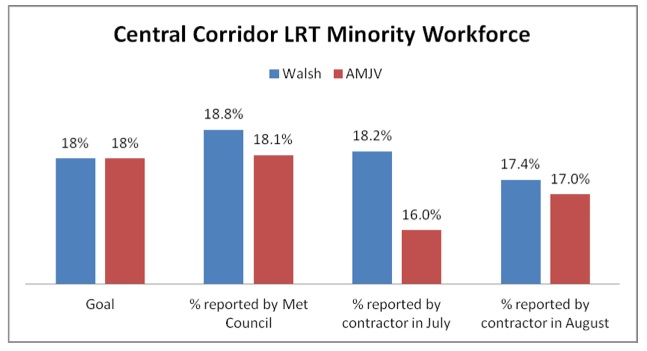
As the Central Corridor light-rail transit line construction continues, disputes continue over the Metropolitan Council’s specific hiring goals that insure women and minority representation in the workforce. While Met Council spokespersons insist that goals are being met, community leaders say that’s not the case. The Central Corridor project’s goal is to make sure 18 percent of construction work-hours go to people of color and that six percent go to women. In monthly public meetings, the main contractors — Walsh Construction, which is responsible for building the eastern seven miles of the light-rail, and Ames-McCrossan, which is responsible for the western three miles — present reports on their progress of meeting the minority hiring goals to the community and the Met Council, which oversees the project. The figures presented by the contractors vary each month — sometimes exceeding the required goal, and at other times falling below the goal. Continue Reading

More Somali refugee families homeless in Minneapolis

Fadumo Isse sat with three other Somali refugee women in the hallway of a homeless shelter in north Minneapolis with her eyes welling up with tears as she told her story of the first six months of her life in the United States. Isse arrived in the United States in late April, hoping to live a contented life: an illusion people in third-world and developing countries have about America, she recalled. After six months in the United States, Isse has yet to live that lifestyle. She lives in a one-bedroom apartment in Mary’s Place — a homeless shelter in north Minneapolis — with her daughter. She is one of 39 homeless Somali families in the shelter, who, like Isse, have recently come from a refugee camp in Ethiopia. Continue Reading