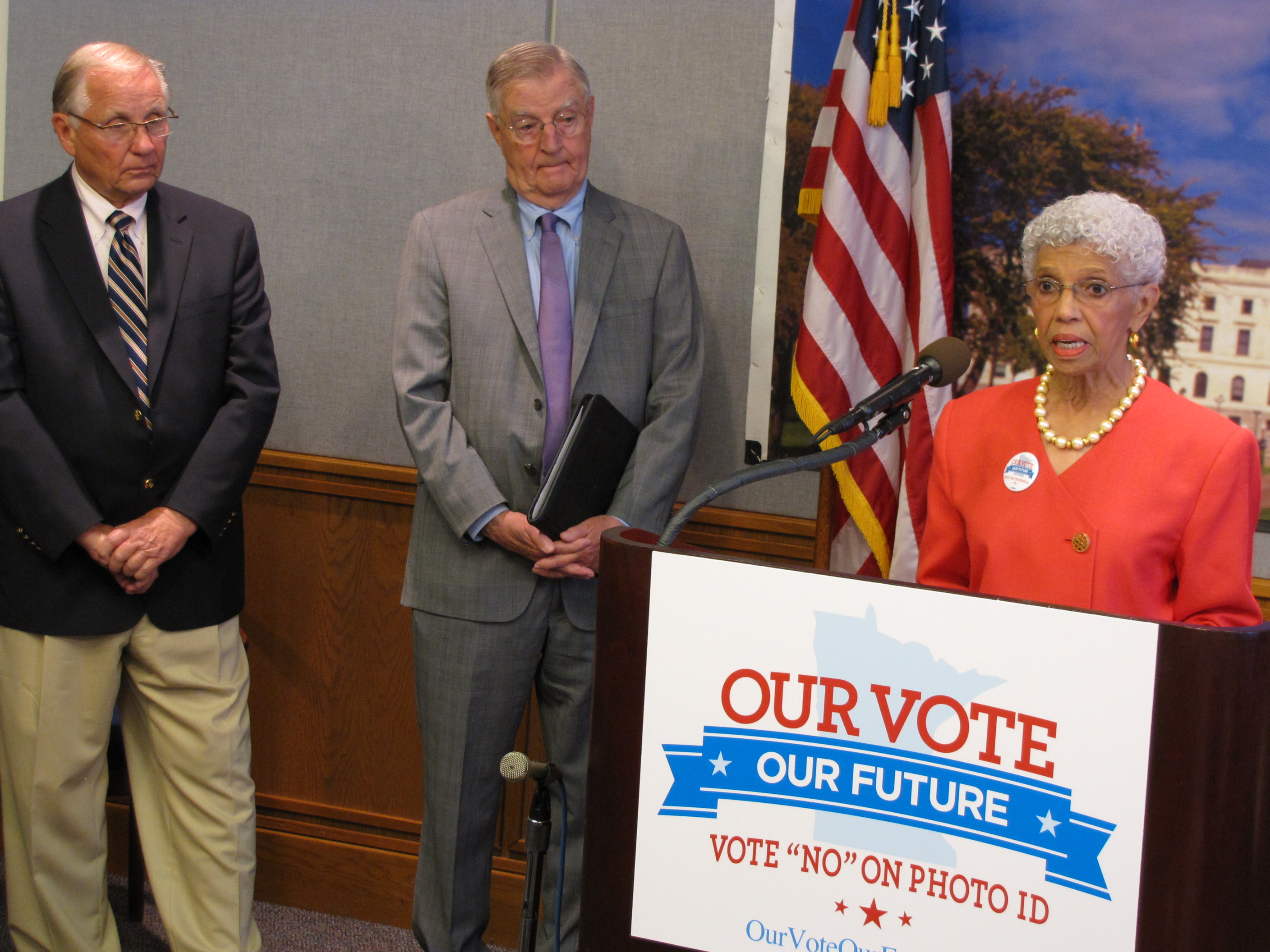
A 2011 Brennan Center for Justice at New York University School of Law report states that voting laws changes will “exclude large swaths of the electorate.” The report added that new restrictions “fall most heavily on young, minority and low-income voters, as well as on voters with disabilities…[making] it significantly harder for more than five million eligible voters to cast ballots in 2012.”“The ballot measure will not only affect voter ID laws but also the ability of Minnesotans to vote absentee…or for Minnesota to maintain the practice of Election Day registration,” explained Keesha Gaskins, senior council for the Brennan Center’s Democracy Program (pictured, below).Gaskins, U.S. Rep. Gwen Moore (D-Wisc.) and U.S. Rep. Keith Ellison (D-Minn.) recently discussed voter suppression legislation in a media conference call co-sponsored by New America Media and the Brennan Center for reporters from around the country, including the MSR.(Photo courtesy of Brennan Center for Justice)“It is very important to understand how these laws are going to affect voters,” said Gaskins.Before Indiana in 2006 became the first U.S. state to do so, no state required its voters to show a government-issued photo ID at the polls in order to vote. Furthermore, federal law requires all new voters who register by mail to show an ID before voting. As the Brennan Center report points out, “What is new, however, is the degree to which the voter ID bills that were proposed and passed.”Voter ID proponents claim that voter fraud has made stricter laws necessary, and that such laws won’t discourage voting by any group. Opponents, however, point out that voter fraud claims are not warranted and essentially are imposing a “poll tax,” whether or not the new identification is offered for free.There are “powerful forces” that support new voter ID laws, believes Moore, who has held a voter ID town hall in her district, which includes Milwaukee. “While all of our rights are essential, I would say the right to vote for everyone isn’t some ideal or goal, but a cornerstone of our democracy,” she reaffirmed.“Voting is a right, not a privilege,” continued Moore. Continue Reading