Though it’s a big sprawling mega-bill, and nowhere near being in any final form that could get President Obama’s signature, I can summarize the proposed federal agriculture legislation, currently being moved through Congress, quite handily: there’s a lot for progressives to dislike. And “dislike” is about the weakest term one can use.
Many of us on staff at the Institute for Agriculture and Trade Policy enjoy an occasional Chipotle burrito. Compared to other casual dining options, the company has done an outstanding job of sourcing antibiotic-free meat from farmers committed to the humane treatment of animals. Continue Reading
Well, this is it. The Senate Ag Committee’s version of the 2012 Farm Bill is up for a floor vote the week of June 4, and boy does it need an overhaul before it’s finalized. The biggest area in need of reform is the massive giveaway of $95 billion over the next 10 years through federally subsidized crop insurance. Crop insurance is an important and needed farm program. Continue Reading
For north St. Anthony Park resident Charlene Chan-Muehlbauer, it all comes down to the health of her 22-year-old daughter. “To protect [her] access to raw milk,” says Chan-Muehlbauer, “I’m willing to go to jail. But to be jailed for something like this—it’s just wrong.”Chan-Muehlbauer is reacting to the latest development in a long-running dispute between the Minnesota Department of Agriculture (MDA) and families like hers, who believe so strongly in the nutritional and curative properties of unpasteurized milk that they’re willing to risk legal sanctions in order to get it.In April, the MDA issued a formal warning that Chan-Muehlbauer and her husband, Gary Muehlbauer, could be subject to criminal prosecution unless she stops using their garage as a drop site for distribution of raw milk shipments from Sibley County farmer Mike Hartmann.It’s a 90-mile drive to the Twin Cities in Hartmann’s refrigerated truck. When the milk arrives at a pre-arranged time, it sits in Styrofoam coolers in Chan-Muehlbauer’s detached garage until the approximately 20 families in her network pick up their allotments.“Sometimes people wait overnight” to pick up their milk share, says Chan-Muehlbauer, but “we’ve all agreed that this is what we want.” She stresses that, aside from purchasing her own share of the milk, she’s not involved in “any financial dealings” with other families. Continue Reading
Minnesota now has a state soil. The designation of Lester as the state soil in the omnibus agriculture law coincides with the University of Minnesota’s 2013 celebration of the 100th Anniversary of the soil science program and the 40-year-old Minnesota Association of Professional Soil Scientists, according to Rep. Paul Anderson (R-Starbuck), who sponsors the law with Sen. Doug Magnus (R-Slayton).However, a large portion of the law will require new labeling of landscape and garden stock designed to help consumers choose hardy stock for Minnesota’s extreme growing conditions.The law is effective Aug. 1, 2012, unless otherwise noted.Planting guidelinesThe new law defines “non-hardy” as a plant that cannot be expected to survive or produce flowers in certain growing zones and requires non-hardy nursery stock to be labeled as such. Sellers of nursery stock will also be required to keep balled and burlapped stock moist at all times.Similarly, nursery stock collected from the wild must be labeled as such when sold, unless it has been grown in nursery rows at least two years; and vegetable and flower seed packets could list the number of seeds in the packet, instead of the net weight.The Department of Agriculture’s nursery and plant inspection and enforcement powers will expand to include the department’s Wholesale Produce Dealer, Grain Buyer/Grain Storage, and Warehouse oversight responsibilities. The department can enter sites, inspect and sample products, issue commissioner’s orders, and pursue administrative and criminal penalties for failure to follow the Wholesale Produce Dealer, Grain Buyer/Grain Storage, or Warehouse laws.Grains and livestockA public grain warehouse operator’s license must currently be filed before the purchase or storage of grain may occur. Continue Reading
When thinking of sustainable agriculture, we usually picture smaller, organic fruit and vegetable farms. However, more of Minnesota’s larger corn, soybean and cattle producers are adopting sustainable methods with programs like EQIP, CRP and others. Growers are working with environmental groups and policymakers to expand conservation’s small share of the Food and Farm Bill set for renewal in Congress.Northfield farmer Dave Legvold has experimented with no-till fields for years, which helps prevent excessive erosion. Continue Reading
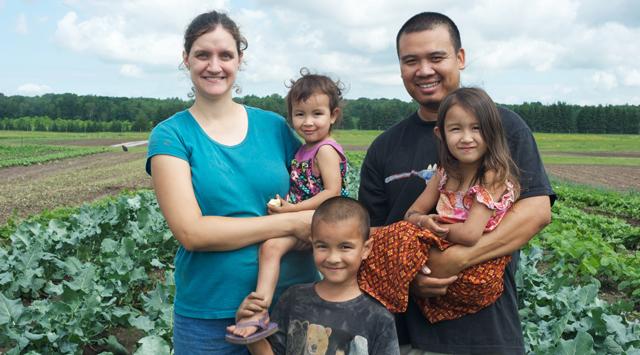
He was born in mountainous Cambodia and dreamed of owning a farm. She was born to the far-reaching plains of the Midwest and flourished in an urban setting of coffee shops and poetry readings.Now, immigrant Proeun and Amy Doeun are married, have four children, a herd of goats and 85 chickens as well as their own 40-acre farm in Rush City. That’s thanks in large part to the Minnesota Food Association, a farm entrepreneurship program she calls “our alma mater.’’That program is but one of many to be highlighted at an upcoming national conference with a title as long and as self-explanatory as many a non-fiction book.Community Sketchbook focuses on the economic and social challenges facing communities, especially low-income communities and communities of color, and how people are trying to address them. It is made possible by support from the John S. and James L. Knight Foundation, The Minneapolis Foundation, and some Minneapolis Foundation donor advisors.Community Sketchbook articleMinnesota 2020s may be republished or distributed, in print or online, with credit to MinnPost and the foundations.“Grassroots and Groundwork: Working Together to Reduce Poverty and Build Prosperity” will showcase both tested and emerging models for helping low-income as well as immigrant and refugee populations to get out and stay out of poverty, planners say. More than 400 people are expected to attend the event sponsored by the Northwest Area Foundation June 6- 8 at Mystic Lake Casino Hotel in Prior Lake.“We believe all communities can prosper,’’ says Kevin Walker, president and CEO of the foundation.Presenters from around the country, including Oregon, Seattle, Philadelphia and the Twin Cities, will talk about programs working to stamp out hunger and poverty. Continue Reading
Leaves are out and the first of the fruit trees have blossomed. At Bull Brook Keep, the plums were first to unfurl their pale pink petals. Unfortunately, they were lured by the premature heat and were kicked back into winter by a couple of nights in the 20s. I think we lost a good 20-25% of those buds, but I think we’ll still get a good showing this summer.
On April 26, the U.S. Senate Agriculture Committee passed its version of the 2012 Farm Bill by a vote of 16 to 5. The bill, which includes $23 billion in cuts over the next 10 years, is anticipated to be brought to the Senate floor for a vote yet this year. Continue Reading
The rain from this weekend needs to continue if Minnesota cows are going to have enough forage to eat this year.Forage is the term for the hay and silage that comes from alfalfa and corn that cows eat, and the drought that the state has experienced since August could hurt its growth.“We need a big corn crop, and we need a good hay crop, and when we have drought, that really could be an economic challenge for cattle producers,” said Jim Paulson, a University of Minnesota Extension dairy educator.The drought has affected every aspect of this interdependent farming system, and many involved said they hope it does not become a trend.Extension climatologist Mark Seeley said many areas of the state are 9 inches below the precipitation average.The second part of the growing season is usually the driest, Seeley said, so the fields need rain and snow at this time of year to build adequate subsoil moisture for the crops to use later.“We’re concerned about this year’s crops,” said local dairy farmer Brian Hazel. “It’s going to take quite a bit of catch-up.”Hazel has a 700-acre farm in Lanesboro, Minn., of which, he said, 450 acres are used to produce food for more than 500 cattle.With the unusually early onset of spring, many farmers wanted to plant early to increase their yield, said Liz Stahl, an Extension crops educator.She said the Extension recommended that farmers not plant before April 21 because there was too high a risk that it would get cold again and hurt the crops — even with warm temperatures this year.Hazel has already planted his hay forage crops and said he plans to plant the row crops like corn this week.Farmers would expect four or five forage harvests in a year with these warm temperatures, Seeley said. But because of the drought, Hazel said he expects as few as two harvests.When farmers harvest less forage, they have to buy more feed for the cows, such as corn.But the production of ethanol has taken much of the corn and the land that cattle might use, according to Hazel.Up to 40 percent of the corn farmed in Minnesota last year went to producing ethanol, Paulson said — about as much corn as animals usually eat in a year.“It’s all about supply and demand, and when you take 40 percent to go to biofuels, it’s obviously going to affect supply, and that’s why we have $6 corn now, instead of $3 corn or $2 corn,” he said.Cows eat feed in a barn Saturday on Hazel’s dairy operation in Lanesboro, Minn. Shortages in forage materials may mean farmers like Hazel will have to buy more expensive corn feeds for their cattle instead of producing their own.Although the price of raw corn has gone up, farmers can feed the byproducts of ethanol to the cows, Hazel said.Many byproducts that are unfit for human consumption are acceptable for bovine cattle to eat because they have multiple stomachs to digest them.“That’s the unique thing about cattle and why we like to see them in the landscape, because they are utilizing plant species that nothing else can use,” Hazel said.Seeley said it was unlikely for a season like this to happen again.The rest of the year could be good for dairy farmers if there is enough precipitation, said Stahl, but there are so many variables that it is difficult to make predictions.Seeley warned against making many predictions at all.“We shouldn’t make a statement that condemns the whole growing season,” he said.Hazel, however, remains optimistic.“If we weren’t optimistic, we wouldn’t be farmers.” Continue Reading