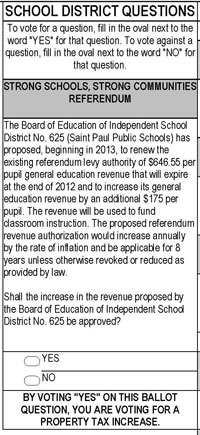
What would a defeat of the St. Paul Public Schools Board of Education’s 2012 Strong Schools, Strong Communities referendum mean in November?
Thirty million dollars in cuts next year, according to Jean O’Connell, chair of board.
For Greg Copeland, chair of the St. Paul Republican City Committee and the referendum’s most vocal detractor, it would send a strong message to 360 Colburn, the district’s headquarters: “You guys are out of control,” he said.
On Nov. 6, voters in the capital city will be asked to say yes or no to a referendum that would provide nearly $39 million a year for eight years (beginning in the 2013-14) to the district—$30 million would extend the expiring excess property tax levy that was approved in 2006 and $9 million would pay for technology that the district says will help personalize lessons for students.
If approved, owners of a median value home—$149,000—would see their property taxes rise by $61 above the $175 levied with the current referendum.
Copeland calls that increase “bad marketing in a time of economic hardship in St. Paul.”
O’Connell acknowledged that this is not an ideal time to ask for more money. “It is a tough economy,” she said, “and asking for an increase any time is asking a lot of people.”
But something that many people don’t understand, O’Connell said, is that St. Paul Public Schools—the second largest district in the state—has the fifth lowest levy in the state’s 37 districts. SPPS ranks just above Farmington, St. Cloud, Shakopee and Brooklyn Center. The current St. Paul levy provides $646 per pupil. Anoka-Hennepin, the state’s largest district, has an excess levy of $1,226 per pupil. Districts in Bloomington, Wayzata, Edina and Minnetonka all have excess levies of $1,500 to $1,800 per pupil.
If the levy increase passes on Election Day, the district would receive $822 per pupil in excess levy funds. Even with that increase, SPPS would stay in the bottom 10 of metro-area districts that have an excess levy, O’Connell said.
Currently, the $30 million that is set to expire funds all-day kindergarten, pre-kindergarten classes for 4-year-olds (the state pays for only half-day kindergarten and no pre-K classes) and Early Childhood Family Education. It also goes toward increased math and reading staff in elementary schools, support for existing English Language Learner programs, federally mandated special education services that are not funded by the state, smaller high school math and science classes and more high school guidance counselors.
The extra $9 million in the referendum would pay for technology that O’Connell said would “personalize teaching to all kids.”
This doesn’t mean that the district is supplying iPads to every child, she said.
The district wants to use technology to help teachers personalize instruction “to make learning better for each kid in the system,” O’Connell said. Teachers will be able to share lessons on line, or use videos from other teachers to teach students who may need extra help or accelerated lessons. Students could access these lessons at home on their computers.
“The idea is to give kids and teachers better materials to use. Parents would have access to grades, schedules, lessons, homework assignments and a lot more information than they do now,” she said. “That costs money. The district has spent less than 1 percent on its total budget on technology. We are woefully behind. In many schools, computers are used more than a third of the time for testing. State MCA tests and other [standardized] tests are all computerized. So rather than our kids having access to those computer labs for classrooms, they are locked out. We are asking kids to do tests on computers when some of them don’t get the chance to use computers other than at test times.”
Copeland doesn’t think the district needs the extra $9 million. “You want to tell me they can’t make adjustments to account for $9 million?” he asked. He also feels the SPPS Board of Education shouldn’t have lumped both asks into one referendum. “They had the opportunity to separate the questions,” he said. Instead, they are saying, “Take it or leave it, St. Paul.”
Last summer, six out of the seven board members voted in favor of putting the renewal request and the increase request as one question on the ballot. O’Connell said she made her decision after the results of a board survey showed that “more than 50 percent of the public would support an increase for schools.”
“We are in a very complicated election year,” O’Connell said, “and with other initiatives on the ballot, specifically the two amendments [voter ID and marriage], the presidential race and other races in the state, we needed to have as simple a message as possible. The one question was that simple message.
“We are not asking for an excessive amount of money when you look at places like Edina,” she said. “The board has tried to use dollars wisely and ask for a minimal amount to make sure our kids get what they need.”
Comment