After nine years away from author J. R. R. Tolkien’s The Lord of the Rings universe, director/writer Peter Jackson can still work his Middle-earth magic. Staying true to his subject material, Tolkien’s 1937 novel The Hobbit, a novel that takes place before the events of the three The Lord of the Rings books (originally published in the 1950s), Jackson pleases fans of Tolkien’s work by letting key scenes from the literary world play out in an unrushed fashion in his film world of The Hobbit: An Unexpected Journey. Jackson does have a few surprises up his sleeve (or do they hide in his bushy beard, I wonder?), however, as he adds some original ingredients of his own to the adaptation of about one-third of a classic page-turning story that readers have devoured for the better part of a century.
The hobbit mentioned in the film’s title is one Bilbo Baggins (Martin Freeman). Parallel to The Fellowship of the Ring (2001), the first film installment of The Lord of the Rings, this hobbit’s story begins in the Shire, a little community of gardens, ponds, and homes built in hills. Bilbo lives a pleasant, if unpredictable, life. He’s complacent living alone at home; books and the tick of the clock are enough to keep him company.
Bilbo’s pleasantly predictable life shatters one day when he receives a visit from Gandalf the Grey (Ian McKellen), an elderly wizard who remembers Bilbo as an adventurous boy years ago at the firework displays he put on. Gandalf’s visit turns out to be more of a summoning. The old wizard is about to go on a quest with thirteen dwarves and has been charged with finding the group’s final member. Seeing positive qualities in bringing with a mundane creature like a hobbit that others would most likely overlook, Gandalf convinces the dumbfounded Bilbo to come on a journey so vast that it will change him one way or another, one possible change being that of death. No, it shan’t be a Sunday stroll through the gardens.
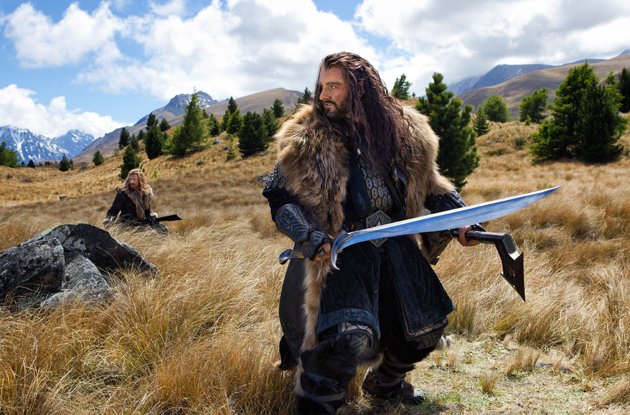
The destination of the journey is the Lonely Mountain, the inside of which used to be home to the dwarves, where they mined enough gold, rubies, sapphires, and silver to make the pyramid stash in The Mummy (1999) look like a crumpled dollar bill on the sidewalk in comparison. Having all that gold lying around was fun to look at, but it attracted the attention of the dragon, Smaug, who literally busted into the mountain and kicked the dwarves out, killing many of them in the process. Thorin Oakenshield (Richard Armitage), the leader of the quest, used to be a prince in Lonely Mountain. Now his grandpa and father are dead, his people are without a home, and he’s mad enough to do something about it. He intends to take Bilbo, Gandalf, and his band of eleven faithful dwarves to his former home to kick out Smaug and take back what belongs to his people. To get there, though, he’ll have to fight dwarves, goblins, trolls, and orcs, as well as learn to trust the sworn enemy of all dwarves: elves. Somehow, Thorin finds that last part to be the most difficult of all.
A fantasy film made in this modern age is bound to contain more CGI than any other film in any other genre, excepting science fiction (it’s rather difficult to actually film a scene in space). Having grown up adoring the work of Tom Savini, Greg Nicotero, and other marvelous make-up artists, I’m one who prefers practical effects to CGI. Jackson’s fantasy films, though, are a major exception to my effects preferences. Jackson and cinematographer Andrew Lesnie make Middle-arth a beautiful place, intertwining the natural beauty of New Zealand—shimmering waterfalls, craggy hillsides, sprawling prairies—with the digitally constructed wonders of a fictional world that we can never know first-hand—towering ruins, impossibly large spiders, giants made out of mountains. The quality of Jackson’s special effects is so top-notch that I sometimes can’t tell what is real and what is inserted into an environment. Jackson’s sweeping, zoomed-out shots of characters running atop mountains and through seemingly infinite boulder-spotted valleys are exhilarating to watch. The film could contain nothing but shots of Middle-earth and it would still be worth your time and the price of your ticket.
Upon hearing that Warner Bros. would be distributing The Hobbit as a trilogy, I thought An Unexpected Journey, containing roughly only one-third of the events of one book, yet still having an extremely lengthy runtime of 2 hours and 49 minutes (that’s 4 minutes longer than The Dark Knight Rises and 3 minutes shorter than Cloud Atlas, for those of you keeping score at home), would feel overlong and contain tiresome material not necessary for the story’s progression. I was pleasantly surprised then, to see that every scene in the film contributes to the story arc in a memorable way, not existing to simply fill screen time, but existing to flesh out characters and foreshadow epic events to come. Because Jackson was able to show nearly three hours on the opening stages of a single book, the meticulous details and realistic pacing usually only found in books is displayed with rewarding effect in this film adaptation. The script, written by Jackson, Fran Walsh, Philippa Boyens, and Guillermo Del Toro, devotes considerable time to events from the book, such as the expedition’s encounter with three bickering trolls in the gray hours before dawn. Jackson and his writers also keep fans of Tolkien’s work wonderfully off-balance by throwing in unexpected cameo-like appearances by hobbit Frodo Baggins (Elijah Wood); the elf mind reader Galadriel (Cate Blanchett); and wizard overseer Saruman the White (Christopher Lee).
The casting department couldn’t have done a better job. Martin Freeman (British TV’s The Office and Sherlock, respectively) is the perfect person to play a young Bilbo Baggins. He makes a great hobbit, the ultimate reluctant hero creature. He bumbles and stumbles his way through caves and forests, but when the time comes to draw a sword from its holster and dig courage from the heart; he’s able to do so with admirable skill, even if he is a little sloppy with his form. Richard Armitage (2011’s Captain America: The First Avenger) is compelling and convincing as the group’s leader. He takes command of the group, leading them on with a stern, militaristic side that’s stripped down to the no-nonsense core from a lot of time spent on the battlefield. And yet, Armitage aptly displays Thorin’s softer side when he speaks of his crew’s loyalty or the golden days of old. Donning the gray robes for the first time since The Fellowship of the Ring, Ian McKellen (2006’s X-Men: The Last Stand) once again conveys the complexity of Gandalf with sincerity, thoughtfulness, and a knowing twinkle in the eye. He’s able to switch between humor and anger so fluidly that it still surprised me even when I expected it.
No, Peter Jackson’s return to Middle-earth is not in vain. Simply providing new material from a universe many people fell in love with over a decade ago would have been enough to make An Unexpected Journey a financial success, but Jackson went leagues farther than that shallow goal by making a movie that’s great on its own standalone merits. If the two sequels are as rich in story and character as this one, then Jackson will have created a trilogy as memorable as The Lord of the Rings. But what’s the point in looking that far ahead when there’s plenty to savor already with this installment?
5 stars out of 5 (A+)
The Hobbit: An Unexpected Journey is rated PG-13, has a runtime of 2 hours and 49 minutes, and was given a wide United States release on December 14, 2012.
Be sure to like Tuesday Movie Men on Facebook and follow us @tuesdaymoviemen. Come join the party, pal! We won’t even turn your car into Swiss cheese (Die Hard reference, ladies and gentlemen, bonus points to those who noticed).
Comment