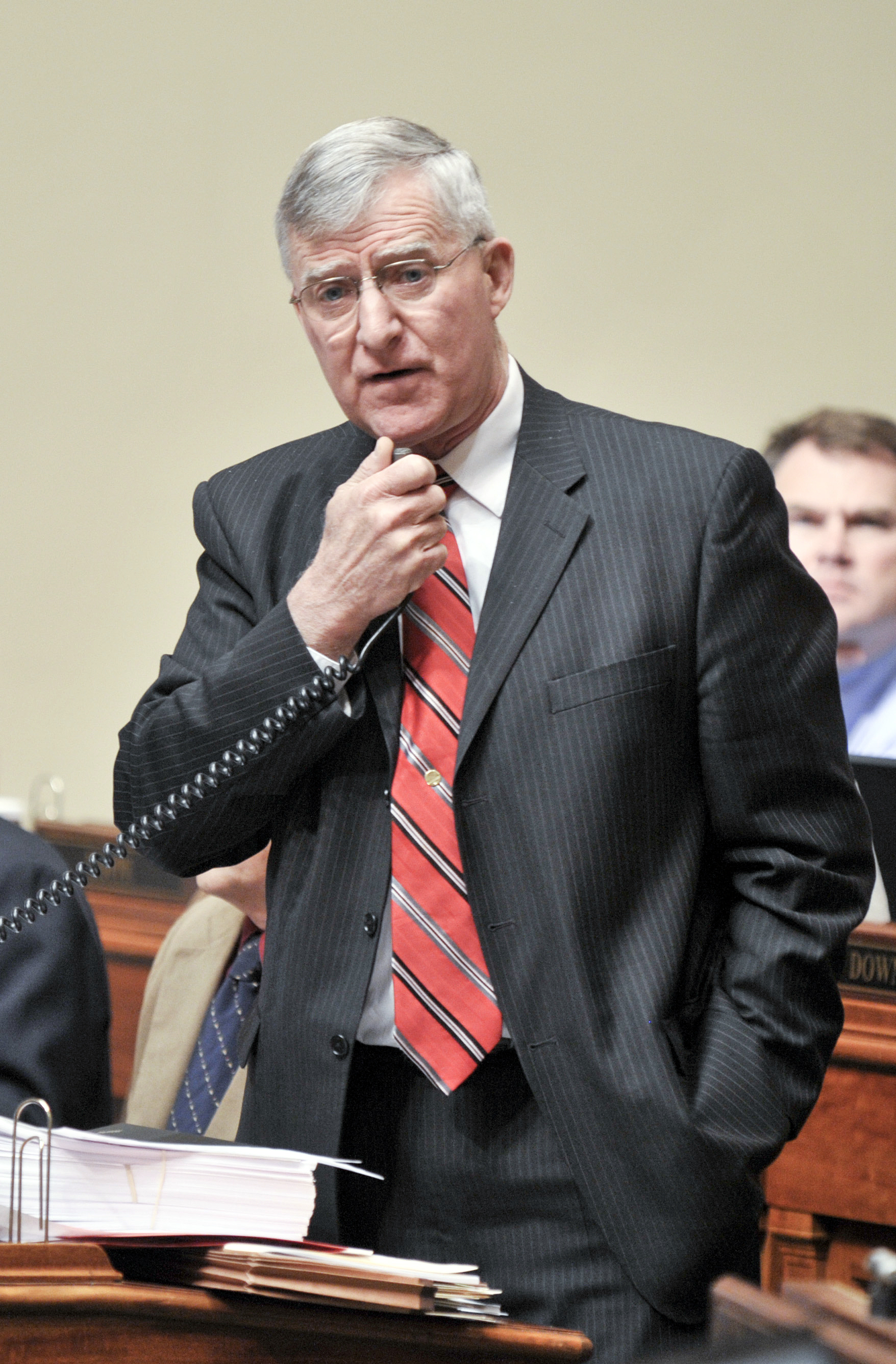
Ag bill receives green thumbs up

Shopping for spring garden supplies and landscape materials would be easier under provisions passed in the omnibus agriculture and rural development bill.Sponsored by Rep. Paul Anderson (R-Starbuck), HF2398 would define “non-hardy” as a plant that cannot be expected to survive or produce flowers in certain growing zones and requires non-hardy nursery stock to be labeled as such.Similarly, nursery stock collected from the wild must be labeled as such when sold; unless it has been grown in nursery rows at least two years; vegetable and flower seed packets could list the number of seeds in the packet, instead of the net weight.Passed 102-20 by the House, the bill now moves to the Senate, where Sen. Doug Magnus (R-Slayton) is the sponsor.The Department of Agriculture’s nursery and plant inspection and enforcement powers would expand to include the department’s Wholesale Produce Dealer, Grain Buyer/Grain Storage and Warehouse oversight responsibilities. The department could enter sites, inspect and sample products, issue commissioner’s orders, and pursue administrative and criminal penalties for failure to follow laws.Also referred to as the Food Safety Bill, it would move enforcement of food safety regulations into a new chapter of law and grant authority for the department to issue civil penalties, in addition to criminal or administrative penalties.Other provisions would:exempt commercial feed producers from paying inspection fees on the portion of feed they use themselves;establish a Dairy Research, Teaching and Consumer Education Authority; andenable the remaining portion of a 2010 Lutheran Social Services appropriation for disaster and mental health relief in rural communities to be expanded to more counties until spent.On the House floor, there was lengthy debate regarding two amendments.Rep. John Persell (DFL-Bemidji) introduced — and ultimately withdrew — an amendment that would have allowed for the home delivery of raw milk. There was bipartisan support and opposition on the topic, which focused on freedom of choice and protecting the integrity of the food supply.An amendment unsuccessfully offered by Rep. Phyllis Kahn (DFL-Mpls) would have urged the president and Congress to remove the trade and travel embargo with Cuba.“The Pope just went to Cuba. Why can’t we go to Cuba too?” Kahn asked. Continue Reading

Breakfasts with Bobby to continue

While other candidates hold rallies and black-tie fundraisers, Rep. Bobby Joe Champion’s (DFL-Mpls) secret to getting elected to his North Minneapolis House seat four years ago was through his constituents’ stomachs.Eggs, sausage, bacon and grits were the secret ingredients to gaining delegates for his first run for public office.“I called them ‘Breakfast with Bobby.’ I would easily get 100 people to show up,” he said.He explained the election process for those who came, helping them to understand why and how they should get involved.“I would say a caucus is just you and your neighbors getting together and deciding who is going to represent you. People call it caucus, but that’s all it is,” he said.It worked so well, he’s planning on doing it again as a candidate for the Senate seat currently held by Sen. Linda Higgins (DFL-Mpls), who is not seeking re-election.He hopes the process is a little easier this time.When he ran for the House in 2008, Champion received the party’s endorsement, but he had a major issue to overcome: the DFL incumbent continued to run against him.“The caucus did not like me because I was running against an incumbent.” Champion said.However, his wife, Angela, supported his decision to run, as did U.S. Rep. Keith Ellison, whose campaign Champion had helped.While many gave him the cold shoulder at the state convention, one House member embraced his desire to serve the North Side.“There was only one person, which is why I respect her to this very day, who opened her arms and gave me a hug on that day — (Rep.) Mindy Greiling. She saw my humanity, not as a person running for office, but as a human being who was being rejected.”Throughout his legislative career, Champion has fought to ensure that everyone gets a chance to succeed.He’s proud of sponsoring the Disadvantaged Business Enterprise law, which certifies a business and enables it to bid for federal-aid highway, mass transit and transportation research and technology projects.“If we don’t want people on safety net programs, then we have to give them an opportunity by which to contract and be employed,” he said.That led to the Targeted Group Business Program legislation that would provide incentives to buyers who purchase from a business owned by women, minority groups or persons with disabilities. The bill awaits House action.He also sponsors a bill awaiting floor action that would require convicted felons to be notified when their right to vote is restored, a problem he noticed firsthand. While door knocking in his district, there were constituents who did not know that their right to vote had been restored. Continue Reading

Deaf treatment options may expand

Children who are deaf, deaf blind or hard-of-hearing and who need mental health treatment would be allowed to reside in facilities outside of Minnesota borders under a bill passed 131-0 by the House.To qualify for Medical Assistance funding, the facilities must be located in a state that is a member of the Interstate Compact on Mental Health. Clients would include children who use American Sign Language as their first language.Currently, children with these special needs don’t have access to 24-hour residential care in Minnesota, resulting in more expensive in-patient placements, according to Rep. Kathy Lohmer (R-Lake Elmo), the sponsor of HF2253.An estimated 2-4 Minnesota children annually require the specialized mental health services for people who are deaf, deaf blind or hard-of-hearing.The bill could save public assistance programs thousands of dollars a day by negotiating less expensive rates at facilities in other states, Lohmer said.The bill now moves to the Senate, where Sen. Michelle Benson (R-Ham Lake) is the sponsor. Continue Reading

Grant criteria for pregnancy counseling passed

Newer facilities that offer “alternatives to abortion” programming would be eligible to apply for grants to counsel pregnant women, under a bill passed 104-28 by the House.Programs currently must have had an “alternatives to abortion” program in place by July 1, 2004.HF2676 changes the grant eligibility date to programs in existence at least one year prior to July 1, 2011. Rep. Larry Howes (R-Walker), the bill’s sponsor, said several new counseling programs have been added since 2004 and that the bill simply changes the date to allow more recent providers to apply for the grants.Other criteria require an applicant to be a private, nonprofit organization and to provide the services to pregnant women free of charge. Services may include medical care, parenting education, housing assistance, adoption services and child care assistance.The bill now moves to the Senate, where Sen. John Carlson (R-Bemidji) is the sponsor. Continue Reading

Nursing home funding models

Ninety-two-year-old Christine Stone spends a lot of time visiting friends in Minnesota nursing homes.“And I’ve been impressed that the care has been at the same level for all patients in all those nursing homes,” said Stone, a senior advocate from AARP.She credits a Minnesota law that requires nursing home residents who pay privately for their care to pay the same rate as those on public assistance.That would change under HF2374, which would allow nursing homes to increase rates 2 percent on private pay residents above those on public assistance.Opponents of the bill fear those on public assistance would receive inferior treatment.Driven to Tiers, a 2004 study published in the Milbank Quarterly, revealed that nursing homes create a two-tiered system of care, with residents on public assistance receiving worse care, according to Rick Varco, political director for SEIU Healthcare Minnesota, which represents 3,500 Minnesota nursing home employees.“It’s wrong to treat residents unequally. This bill will lead to unequal treatment,” Varco said.But nursing homes say they can’t afford to care for residents at the rates paid by Medicare and Medicaid. Every day, they are providing care at a deficit of $28 per resident, according to Aging Services of Minnesota. The Department of Human Services acknowledges there is a problem.Rep. Steve Gottwalt (R-St. Cloud) supports the bill, saying, “We’re forcing everybody to pay below cost. Continue Reading

One less Anderson in the House, as Representative Bruce Anderson runs for Senate

Four House Republicans share the last name Anderson. Next year the House will lose “Anderson, B.,” but Rep. Bruce Anderson (R-Buffalo Township) hopes to add his name to the Senate rolls. He’s running for the District 19 seat currently held by Sen. Amy Koch, who is not seeking re-election.That wasn’t his plan. He’s represented District 19A for 18 years, and his goal was to step down after 20 years, which he thought was “a good round number.” But a higher power has other plans, he said.“God always says, ‘My ways are not your ways.’”That became clear to him years ago and he has been reminded often whether in or out of public office.For example, he always thought he’d inherit the family dairy farm. But he joined the U.S. Navy and was assigned to work on aviation electronics in Norfolk, Va., which is where he met his first wife, Dottie. Continue Reading

Licensing and inspections for abortion clinics

Abortion clinics aren’t subject to the same licensing and inspection requirements as hospitals and surgery centers. Rep. Mary Liz Holberg (R-Lakeville) sponsors HF2340 that would change that.The bill would require a clinic or health center that performs at least 10 abortions per month, including nonsurgical abortions, to be licensed and inspected by the Health Department.The House Health and Human Services Reform Committee approved the bill on a vote of 14-6 March 14 and referred it to the House Government Operations and Elections Committee. Sen. Claire Robling (R-Jordan) sponsors a companion, SF1921, which awaits action by the Senate State Government Innovation and Veterans Committee.Under the bill, patient data would be protected by data privacy laws and inspections would not require advance notice. Andrea Rau, a legislative associate for Minnesota Citizens Concerned for Life, said the bill is needed to help insure that women’s health is protected through the use of clean facilities and proper procedures.A Philadelphia case involving a doctor who allegedly delivered seven babies alive and then used a scissors to sever their spinal cords in unclean conditions was the catalyst for the proposed legislation, according to Rau.The provision could affect an estimated seven clinics that perform 98 percent of abortions performed in the state.Opponents said the bill singles out abortion clinics and hold them to a different standard than other types of clinics that don’t require licensing and inspection, such as those that perform colonoscopies.Holberg said the fiscal impact will be challenging. A preliminary fiscal note estimates a $300,000 cost for the department to promulgate rules concerning licensing and inspections. Continue Reading

Health Care Compact bill receives committee approval

Minnesota has moved one step closer to joining other states in forming a compact to assert its right to reclaim federal funds to provide public health care for its own residents.The House Health and Human Services Reform Committee approved HF2339, which would allow the state to join other states in requesting that Congress return each state’s Medicaid contributions to be managed as each sees fit. Sponsor and Committee Chairman Rep. Steve Gottwalt (R-St. Cloud) said that the state could use block grants to redirect the funds without federal strings attached.The committee referred the bill to the House Government Operations and Elections Committee.“We cannot defend the status quo. The current system is not sustainable,” said Dan Tripp, national field director for the Healthcare Compact Alliance. Tripp said the current Medicaid program is on track to become insolvent by 2025.American Indian and Veterans Affairs programs would not be included in the states’ initiative.The bill is a “philosophical step” toward state sovereignty and does not specify who would be covered or what benefits would be included, Tripp said.Rep. Sandra Peterson (DFL-New Hope) said allowing some states to opt out of the federal health care program may serve to “hasten Medicaid’s demise.”Other states that have joined the compact include Georgia, Oklahoma, Missouri and Texas.Sen. David Hann (R-Eden Prairie) sponsors SF1933, a companion bill that awaits action by the Senate Health and Human Services Committee. Continue Reading

House committee approves relaxing HMO regulations

A requirement that Minnesota health maintenance organizations participate in a bid process to provide services for state health care clients would be modified under a bill approved by a House committee.Rule 101 currently requires HMOs to participate in Medical Assistance and MinnesotaCare programs if they want to provide health plans for state and local government employees.HF1166 would exempt HMOs from the requirement and would repeal a provision that requires them to participate in Medical Assistance and MinnesotaCare as a condition of receiving a certificate of authority from the health commissioner to operate as an HMO.Rep. Steve Gottwalt (R-St. Cloud) sponsors the bill, which was approved by the House Health and Human Services Finance Committee as amended and referred to the House floor. Gottwalt said removing the requirements would invite exploration of new service delivery models. But minority caucus members said not requiring participation may result in a lack of access to services in rural areas of the state where there are fewer choices.Rep. Tina Liebling (DFL-Rochester) said it also may mean that Minnesota won’t comply with a federal law that will require there be a choice of more than one health plan for consumers.Kathryn Kmit, director of policy and government affairs for the Minnesota Council of Health Plans, said Minnesota is the only state that requires all HMOs to be non-profit and to bid on providing Medical Assistance and MinnesotaCare services. Two of the plans are exclusive to public service programs and it’s unlikely that they would discontinue serving this population.SF1145, a companion sponsored by Sen. David Hann (R-Eden Prairie), awaits action by the Senate Health and Human Services Committee. Continue Reading

Reforming Mahnomen County

Counties have been the state’s vehicle for delivering health and human services for years, but the White Earth Nation in northern Minnesota is on track to become the first sovereign nation to take over those responsibilities for its own community.“It’s just a really cool moment in time when we turn back something that (the White Earth Nation will) do well at. Seldom do we get to celebrate a moment like this. We mostly face challenges. We don’t get to celebrate successful moments,” said Rep. Jim Abeler (R-Anoka), chairman of the House Health and Human Services Finance Committee.The White Earth Nation received legislative authority last year to provide human services to Mahnomen County residents. The county is entirely located within reservation boundaries, although about 55 percent of county residents are non-tribal.Transferring authority for service delivery, such as child welfare, chemical dependency and employment, could save the state millions of dollars in Medical Assistance health care costs, say proponents because the federal government reimburses sovereign nations 100 percent for Medical Assistance costs, according to Monte Fox, White Earth health director.“That’s where our savings is going to be for the state,” Fox said.About 70 percent of Mahnomen County’s current case load is American Indian. Continue Reading