Tax bill moves through House

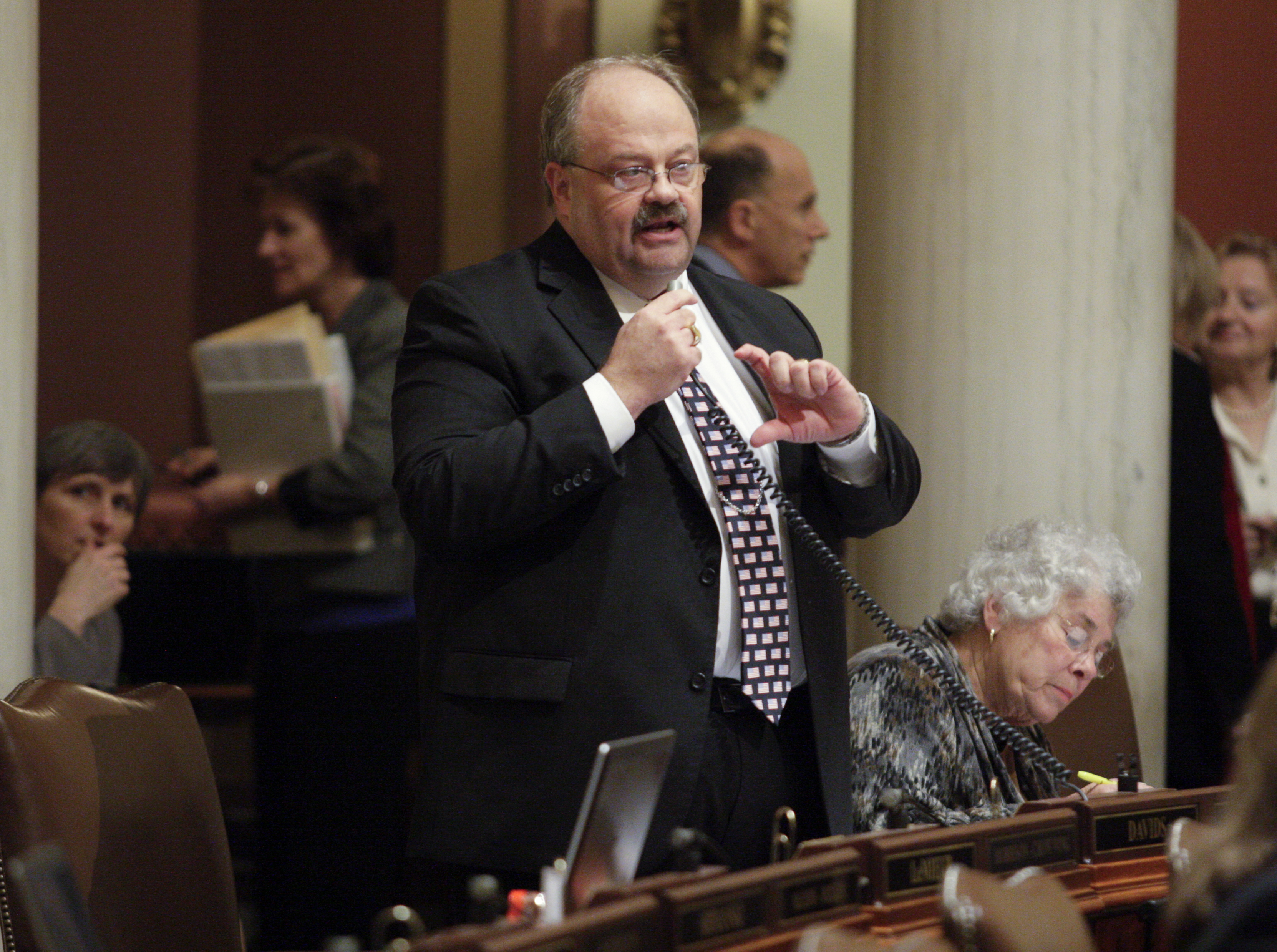
A phase-out of a state property tax levy paid by seasonal/recreational property owners and business property owners is the cornerstone of  HF2337, the omnibus tax bill. But critics say the tax benefit comes at the expense of renters, namely seniors and the poor, through a decrease in the renters property tax credit.The bill passed the House March 21 on a 72-62 party-line vote and now goes to the Senate, where Sen. Julianne Ortman (R-Chanhassen) is the sponsor.Sponsored by House Taxes Committee Chairman Rep. Greg Davids (R-Preston), the bill’s journey to the floor came after a week of committee testimony, including a nine-hour meeting where the DFL put forward approximately 20 amendments, with few being accepted. On the House floor, however, only two were proffered, and both were accepted by Davids.He said the bill’s provisions are aimed at improving the state’s business climate by phasing out the state property tax levy over 12 years beginning in 2014 and excluding 70 percent of the first $150,000 value of all business property in 2013.The bill would also:freeze local government aid at 2012 amounts;provide targeted tax relief for homeowners equal to 90 percent of any tax increase over 12 percent for pay 2012 only;replace the foreign operating cooperation deduction with a tax credit;increase, in some cases, the research and development tax credit, as well as the angel investment credit;reinstate the bovine tuberculosis property tax credit;provide a jobs credit for businesses hiring qualified veterans; andcreate an internship grant program administered through the Office of Higher Education directed to attracting youth to Greater Minnesota businesses.To prevent these credits and the phase out from negatively impacting the General Fund by more than $69 million in fiscal year 2013, the current renters credit would be decreased with some relief provided for qualified seniors and people with disabilities.The bill would reduce the credit from the current 17 percent to 15 percent. Last year’s budget agreement reduced the credit from the previous 19 percent.Rep. Steve Drazkowski (R-Mazeppa) told members to call the renters credit what it really is: “The renters credit is a subsidy. They don’t pay property taxes.”DFLers fault the bill on two premises: it represents misplaced priorities by having businesses benefit at the expense of renters, and it is not fully funded in future years, leaving a $900 million deficit by fiscal year 2019.“This is not Minnesota nice,” said Rep. Paul Marquart (DFL-Dilworth). Continue Reading

Bonding bill gets lukewarm opening reception

A $280 million bonding bill was met with a lukewarm response during its debut in the House Capital Investment Committee.“It’s on a long journey to the governor’s desk, and I assume it will change many times,” said Rep. Larry Howes (R-Walker), the committee chairman and sponsor of HF2622. Even the roll-call vote to move the bill to the House Ways and Means Committee March 21 was ambiguous. Both the yes and no votes crossed party lines; some members passed, and others explained they would approve the bill only in hopes that it gets improved as it moves along.The bill would support few new construction projects, but would provide maintenance and repair funding for state assets, including: • $46 million to the Department of Employment and Economic Development, with $15 million targeted for economic development grant programs; • $44 million to the Minnesota State Colleges and Universities system; • $39 million to the University of Minnesota; • $38 million to the Department of Transportation for road, rail and bridge improvements; • $21 million to the Department of Natural Resources for dam, road and bridge construction as well as some park development; and • $14 million to the Department of Corrections for asset preservation.Rep. Alice Hausman (DFL-St. Paul) was unsuccessful in her attempt to amend the bill to total $879 million, $119 million more than the total proffered by Gov. Mark Dayton. Not only would it have funded the top four priorities of the various state departments, including $198.9 million to DEED and $102 million to MnDOT, it would take advantage of federal matching dollars for some projects.“People are still hungry for jobs — architects, engineers and construction workers. The taxpayer’s dollars go further today because interest rates are low,” she said.But Rep. Steve Drazkowski (R-Mazeppa) pointed to the state’s increasing debt service payments.“This isn’t money that just falls like manna from heaven. Continue Reading

Session’s first vetoes draw Republican ire

Gov. Mark Dayton’s veto of four tort reform bills, promoted by the Republicans as needed to improve the state’s business climate, dominated legislative leaders’ Friday media availability.House Speaker Kurt Zellers (R-Maple Grove) called Dayton’s rhetoric toward Republicans unproductive. In announcing his vetoes, the governor said the bills are right out of a conservative Washington think tank and favor special interests.“He can call us names. He doesn’t owe us an explanation, but he owes one to the businesses” that support changes to the system, Zellers said.House Minority Leader Paul Thissen (DFL-Mpls) said he was glad to see the governor veto “anti-consumer legislation.”Zellers left open the door that the bills could be reworked and put forward again. “I’m not a quitter. … This is what business owners want,” he said.Zellers also commented on Thursday’s House passage of a bill (HF1766) that >ould prevent union deductions from state child care assistance payments. Continue Reading

Caucus, smaucus- I’m not going and here’s why

What are you doing Tuesday night? I’ve got my fingers crossed that Parenthood will finally have a new episode on TV. Otherwise, I’ll finish the book I’m reading called the Marriage Gift, about slavery before the Civil War. “You’re not going to a caucus?” you ask. No, I’m not. I pre-wrote a column about the last presidential cycle when there were lines to get into the caucuses. Continue Reading

Retailers ask to level playing field with Internet sellers

It’s called the Amazon bill. It’s a proposal aimed at bringing in the millions of sales tax dollars currently not being collected on Internet sales. But it’s a complicated issue that may only be resolved by federal action.Rep. Greg Davids (R-Preston) sponsors HF1849 that begins to attack the issue by putting a definition to the term “solicitor.” Heard by the House Taxes Committee, which he chairs, no action was taken on the bill. There is no Senate companion.Retailers having a physical presence in the state collect sales tax under current law. But some definitions need clarification in these days of so-called “cloud” sales. Continue Reading

Quartet of tort reform bills get House OK

Is our litigious society putting Minnesota businesses at a competitive disadvantage, or are civil suits the only way consumers get their claims addressed? That was the gist of a six-hour House debate on four “tort reform” bills, the first of the Republican’s Reform 2.0 agenda.The four bills passed the Senate in the last days of the 2011 session, but did not receive consideration on the House floor. Each will return to the Senate.Republican sponsors said the bills address lawsuit abuse and propose reform designed to improve the business and job climate in Minnesota.However, DFLers countered that the bills rig “the system against Minnesota consumer and small businesses,” in favor of corporations and insurance companies.House Minority Leader Paul Thissen (DFL-Mpls) said these bills have nothing to do with getting people back to work, and are an attack on the middle class and small businesses that may be suing large corporations.“The courts level the playing field between big corporations” and those with little power,” said Rep. Tina Liebling (DFL-Rochester).Rep. Pat Mazorol (R-Bloomington) and Sen. Julianne Ortmann (R-Chanhassen) sponsor HF770/ SF530* that would change how interest rates are computed before and after judgments. It would lower the awards from the current10 percent flat rate to a market-driven rate with a floor of 4 percent.“This bill gives certainty to the judicial process,” said Mazorol.After voting down 10 minority-sponsored amendments, the bill was passed 75-55.In addition to increasing the threshold for filing a civil action in conciliation court from $7,500 to $10,000, HF211/ SF149*, sponsored by Rep. Doug Wardlow (R-Eagan) and Ortman, would address the right of appeal in class action suits. It would permit a court’s order related to certification of a class to be appealed before the case moves forward.Wardlow said this would expedite the process, saving the state approximately $41,000 annually. Continue Reading

Tort reform bill headed to House floor

On the last day of the 2011 regular session, the omnibus torts bill generated several hours of debate on the House floor before being tabled. It appears the bill will be the body’s first bill to be considered this session. However, most of its provisions have been eliminated.Rep. Doug Wardlow (R-Eagan), the sponsor of HF211/ SF149*, told the House Ways and Means Committee that his delete-all amendment strips all but two provisions from the bill, and called it largely noncontroversial, having been vetted by committee last year. The committee approved the new House language and moved it to the House floor where it is expected to be acted upon Wednesday.In addition to increasing the threshold for filing a civil action in conciliation court from $7,500 to $10,000, the bill would address the right of appeal in class action suits by permitting a court’s order related to certification of a class to be appealed before the case moves forward. Wardlow said this will expedite the process, saving the state approximately $41,000 annually. Continue Reading