
Agree or disagree with a policy, the one thing that I can’t stand is people who spread misinformation or those who criticize based off of inaccurate information. City policy is oftentimes complicated. However, people hear stuff, usually when the media actually decides to report about it, and then they jump in all angry when they don’t actually know all of the facts and context. This past election cycle I phone banked and door knocked for two different campaigns, and I found myself constantly in irrational arguments with voters about some city policy.
This article is reposted from TCDP media partner Streets.MN. Check out the links below for other recent Streets.MN stories:
By now most of you have heard about the new moratorium in SW Minneapolis on teardowns and construction of single-family homes. I have already heard plenty of inaccurate criticisms. The one that gets me worked up the most is “looks like the City Council isn’t serious about increasing density and population after all.” What is happening in SW Minneapolis is single-family homes are being demolished and replaced with new, albeit significantly larger, single family homes. There is no increase in density or population associated with this activity. There are many other examples that I won’t get into here.
The actual content of the moratorium is as follows:
Amends Title 21 of the Minneapolis Code of Ordinances relating to interim ordinances by adding a new chapter 590, providing for a moratorium on the demolition, new construction, or establishment of single or two-family residential dwellings in the R1, R1A, R2, and R2B Zoning Districts in the neighborhoods of Linden Hills, Fulton, Armatage, Kenny and, Lynnhurst.
Council Member Linea Palmisano, who introduced the moratorium, has provided detailed responses to a good number of frequently asked questions regarding the moratorium. The FAQ below is republished from the City of Minneapolis website:
Q: Why do you think this is one of the most pressing concerns for the Ward?
A: “During the campaign, I walked every block in the 13th Ward three times and knocked on thousands of doors. The most frequent and emotional, neighborhood-specific issue in these neighborhoods was personal distress the impact of new residential construction on their day to day experience of their block. Since taking the oath of office in January, and seeing the volume of things escalated to our ward office, it has become very clear that this is indeed a significant issue for the residents of the 13th Ward. Our zoning and building inspectors spend an inordinate amount of time investigating and addressing complaints, which delays the inspection process. Half of my own staff’s time is spent chasing issues that should never have occurred in the first place.
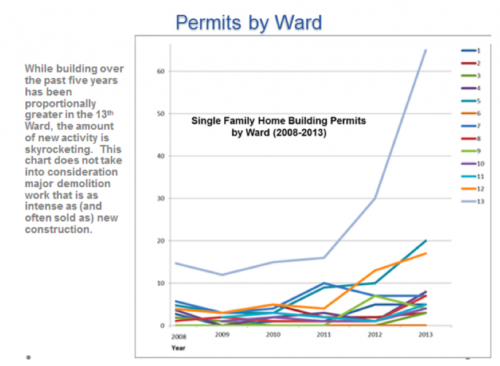
“To provide some historical perspective:”
Q: From the city perspective, why a study on just these five neighborhoods? Why are you just looking there?
A: “This is a project to focus on change and innovation. With this interim ordinance, we have launched a major study in our already built environment. These five neighborhoods have many multiples the number of housing redevelopment as the rest of the 78 neighborhoods in our city combined. The people living here feel the effect of a lot of development quickly and the issues around it are felt in a very concentrated way this makes it a good candidate for study.
“There is a tremendous amount of housing re-development in a very small part of our city, and very little in the rest of it. How can we get better at this, in a way that builds refreshes quality homes that will survive into the next generation? How can we do better at new development? The solutions that we develop here will help us to innovate and do improvements that will have a positive effect throughout our city. We want parameters that work better for everyone involved, and most especially the residents of our city.”
Q: Why wasn’t this communicated in advance? Is that legal?
A: ”My primary concern is for the residents of this ward and the long term health of our city. I am a big believer in transparent government. At the same time, there are significant downsides to announcing an impending moratorium before it’s enacted. If we had telegraphed this moratorium in advance, we anticipated the reaction would have been a rush on wrecking permits. This is exactly what the City of Edina saw just before their code was tightened recently. This would have created even more distress for the very residents already impacted. We would never choose to cause a rush on the exact behavior we are working to modify. This is the same mechanism by which we have had moratoriums put in place in the past and within the last two years in our area. This does not require notice or a hearing before a moratorium can be effective, however, now that the interim ordinance is in effect, there will be a public hearing and a public process prior to another City Council vote on the matter.”
Q: There is zoning code that regulates home size. Why not just look into updating the code?
A: ”Moritoria protect a planning process. This moratorium authorizes the department of Community Planning and Economic Development (CPED) to undertake a study to propose amendments to the City’s official controls and other regulatory devices that the department deems necessary. CPED will be studying the zoning code to determine whether it needs revision, and instituting the moratorium protects the planning process so that efforts can be focused on the study rather than on reviewing land use applications while further homes are demolished. While the CPED study is underway, Ward staff, Department of Health staff and Regulatory Services staff will also be looking at issues related to enforcement of construction-related ordinances, and how to get better compliance from neighborhood builders.”
Q: Who does this affect?
A: ”As written in draft form at this point, any entirely new single-family home or duplex in the R1, R1A, R2, and R2B zoning districts in neighborhoods of Linden Hills, Fulton, Armatage, Kenny, and Lynnhurst are affected. In effort to also address “virtual teardowns” (i.e. teardowns done via a remodel permit), additions of over 1,500 sq. ft. are affected as well. There are exceptions:
- If you have received permits to wreck or build prior to the enactment of the moratorium, you are exempt.
- If you already submitted completed applications to wreck or build, you are exempt from the moratorium.
- If your property is hazardous and must be razed, you are exempt from the moratorium. o
- If your project has already submitted an application for a variance related to the structure (not the lot), you are exempt from the moratorium.
“It is important to note that we value and encourage all other types of projects and improvements to our housing in these neighborhoods during this time.”
Q: I recently bought a lot and hired an architect. This moratorium will cost me thousands of dollars. Can I get a waiver?
A: “There could be a number of reasons why someone would be faced with a hardship as a result of the moratorium. If you are interested in applying for a waiver, it may take up to eight weeks for processing. You may contact our office or the Planning Department to begin this application.”
Q: What are the problems we are trying to solve?
A: “There are a few categories of problems we are aiming to solve.
“The first category includes problems around construction management; we spend a significant amount of City resources chasing down builders based on complaints, mainly about safety, permanent and temporary damage to property (of neighbors, sometimes more than adjacent properties like in issues of basements, structural integrity, water management), and also damage to public/city assets like our streets, trees, curbs, etc.
“The second category includes a deep look at how we might be able to do better in code or setbacks for the massing, placement, and street experience around new structures. This includes environmental degradation. Old growth trees are damaged or removed as homes are excavated and rebuilt. Builders who dig too deeply into the water table can create a constant discharge of groundwater, causing a nuisance for adjacent properties when a stream runs in the curb and gutter as well as down the alley. For example, in some situations, Department of Health staff work with the developer to stop the discharge, but that must be monitored periodically and randomly. Many of the soils in our area— see map here—have little ability to absorb storm water, which causes runoff problems and storm sewer overload even from those homes within code for impervious surface area. We will use this pause to take a fresh look whether our zoning standards are in need of revision to address those issues.
“I want to assert that the 13th Ward prides itself on its environmental stewardship. We’ve spearheaded curbside composting for their community. Our farmers markets are bustling. Bike paths are well used for those who choose non-motorized transportation. And this is an area where I see us being able to take an active role in how we build within our already built environment, in a way that supports the future. For example, sensitive deconstruction is something I am personally passionate about and working to institute.”
Q: Dumpsters, idling and noise are small nuisance issues. Isn’t a moratorium a harsh response to those kinds of complaints? Why not just hire more enforcement officials?
A: “A complaint about one thing often can lead to a string of other and more serious issues when an inspector goes out. For example, an anxious report about a port-o-potty on the boulevard recently led to several site violations, the most serious of which included a stop work order because they had not built the house to the site plan.
“If you haven’t lived with construction all around you—as many unlucky neighbors have—you might classify these as nuisance issues. But to the people who live with the combination of ground-shaking excavations, the hum of generators, the incessant pounding of nails on a Sunday morning, the dust that covers every surface of their home, the inability to park or to walk down the sidewalk or to have their streets plowed—these are more than simple nuisances. Further, there is no such thing as “construction season” anymore—the work does not end when the ground freezes.
“Other neighbors have far worse experiences, having their basements flooded, foundations damaged, or their sidewalks cave in due to construction activity next door.
“Sure, the City could spend resources hiring more inspectors, or we could increase fines. But those are band-aid solutions to the daily problems of just some builders in the bunch. Rather, I am really looking to improve the process and make housing activity stronger across the city. The builders, too, need to agree to better practices in helping to prevent these issues.
“What we need is not to spend more City resources on enforcement. We need better compliance from builders, which will in turn make neighbors—and eventually, occupants—happier and safer.”
Q: These new homes bring in more tax revenue for the City and lower the taxes assessed to everyone else. Don’t you want that?
A: “While those are important considerations, these new homes are also artificially raising the property values for nearby homes that have not been touched, and many of those nearby homeowners—particularly seniors and those on fixed incomes—have great difficulty affording large and sudden jump in their taxes.”
Q: Is there still time to change what’s included in the ordinance?
A: “Absolutely. The ordinance is subject to revision until March 28, the next meeting of the full City Council. You may send your comments to our office.”
Q: How can I make my voice heard?
A: “The Zoning & Planning Committee of the City of Minneapolis will conduct a public hearing at its regular meeting to be held Thursday, March 20, 2014, at 9:30 a.m. or shortly thereafter, in Room 317 City Hall, 350 South 5th Street, to consider an ordinance amending Title 21 of the Minneapolis Code of Ordinances relating to Interim Ordinances, by adding a new Chapter 590, providing for a moratorium on the demolition, new construction, or establishment of single and two-family residential dwellings in the R1, R1A, R2, and R2B Zoning Districts in the neighborhoods of Linden Hills, Fulton, Armatage, Kenny, and Lynnhurst.
“The City of Minneapolis invites and encourages participation by everyone who’s interested in this topic. Should you require an accommodation in order for you to fully participate, or should you require this document in a different format, please let us know by contacting 311 at least five days prior to the meeting.
“For updates and the agenda, keep an eye on the Zoning & Planning Committee website.”
Q: How long will it go on?
A: “State statute allows moratoria up to a year in duration. We are working as hard as possible to develop an aggressive timeframe for this study, and will modify this as we continue to receive feedback from all groups. We would like to get through this as quickly as possible, and with more people at the table, we have everyone’s attention.”
—
This is a significant policy decision. So let’s discuss and have a debate on the effects of this moratorium. However, let us please keep our comments grounded in reality. The moratorium won’t take fully take effect until the City Council approves it on March 28th, so public comments are still welcome. Feel free to send any questions or comments directly to Council Member Palmisano’s office: linea.palmisano@minneapolismn.gov, (612) 673-3199.
Comment