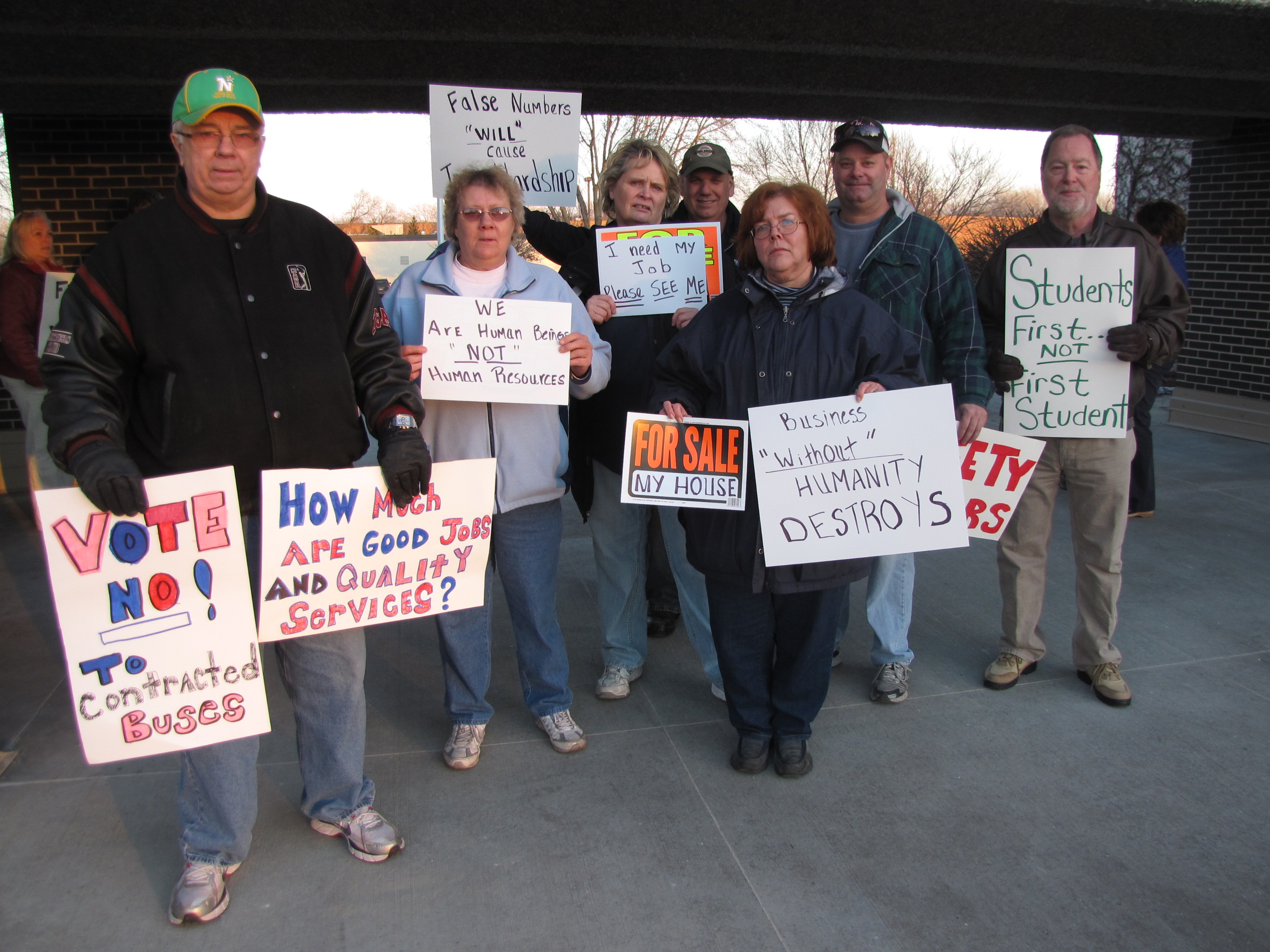
Robbinsdale school board nearing vote to outsource jobs of school bus drivers
|
Never mind a combined total of 500-plus years of service by dedicated school bus drivers.
Twin Cities Daily Planet (https://www.tcdailyplanet.net/author/steve-share/page/4/)
Never mind a combined total of 500-plus years of service by dedicated school bus drivers.

Union members reported for work February 1 at American Crystal Sugar’s East Grand Forks factory. Instead of going inside to their jobs, however, they remained outside the gates of the factory where they were locked-out from their jobs six months ago to the day — and instead hollered at scabs going inside the plant.The action today was one of four similar actions at American Crystal Sugar factory gates the past two days in Hillsboro and Drayton, North Dakota, and Moorhead, Minnesota. “We’re just here today to show the company and the farmers and the community that were ready to go back to work,” said Scott Riplinger, who co-chairs the solidarity committee at the East Grand Forks plant for the Bakery, Confectionary, Tobacoo and Grain Millers Local 167G Unit 264. Riplinger, who lives in Manvel, North Dakota, is , a 28-year company employee and ion technician.In East Grand Forks, about 30 union workers stood with signs outside the plant gates as scab workers drove cars inside. “Go back scabs, go back!” they shouted.The action came two days after the latest federal mediation session between the company and BCTGM ended with the company continuing to insist on a July 28 contract offer which union members voted down by a 90 percent margin.“It’s hard to negotiate when only one side is negotiating,” said Ken Lamberson, assistant head steward and co-chair of the solidarity committee. Continue Reading

After six months locked out by American Crystal Sugar, union workers in the Red River Valley are only growing stronger in their resolve to insist on a fair contract.The company locked out 1,300 workers August 1, 2011 when they voted down a contract proposal by a 90 percent margin. The workers — members of the Bakery, Confectionary, Tobacco and Grain Millers union –this week have been organizing “back to work” actions outside factory gates in Hillsboro and Drayton, North Dakota and East Grand Forks and Moorhead, Minnesota.”We look forward to when we can go back to work,” said Lee Schlichtmann, Hillsboro, a process technician with one year at the company. “Sometimes you need to fight for what’s right.””If they continue to offer us what they’re offering us right now, I see all the union people holding out,” said Paul Woinarowicz, Drayton, a maintenance planner with 32 years at the company. “We lose this and other companies are going to use this for precedent. We’re not going to lose this.”Brad Nelson, Drayton, vice president of BCTGM Local 167G, said he told a company executive: “will you quit sending letters to the employees–you’re doing nothing but aggravating them.”A group of about 15 locked out workers talking with a reporter in a BCTGM member’s garage in Drayton said they believed the company’s offer would now lose a vote by more than 95 percent.The company reported record profits in the year before the contract was up for renewal, they noted. Continue Reading
January 19 was the coldest night of the winter — so far — but that didn’t deter a roomful of union members from turning out to Champlin City Hall to learn more about a coming threat: a proposed “Right to Work” amendment to the Minnesota constitution. Union members at the meeting, organized by the Minneapolis Regional Labor Federation, would learn that the drive to bring “Right to Work” to Minnesota is part of a national campaign funded by the same group of corporate CEOs pushing for similar legislation in other states.”It’s a coordinated national effort to take out unions and eliminate working peoples’ voices in the workplace and in politics,” they would hear from Adam Robinson, MRLF community and political organizer.First, however, Robinson posed a question to the group: “What are some of the values and benefits you receive from belonging to a union?”The room of some 60 union members didn’t need much prompting. People quickly shouted out: a living wage, health care, safety, training, pensions, “building strong communities” and “being treated fairly and respectfully in the workplace.”One person cited a bumper sticker she had seen: “The middle class: brought to you by your union.””These are the things we’re fighting for when we talk about stopping ‘Right to Work,’” Robinson explained.In the 22 states which currently have “Right to Work” laws, wages for union and non-union workers are an average of $5,538 per year less than in states without such laws. Employers in “Right to Work” states also are less likely to offer benefits like health insurance and pensions.The broader community suffers, too, when workers’ collective power is undermined by “Right to Work” laws.According to the U.S. Bureau of Labor Statistics, the rate of workplace deaths is 50 percent higher in “Right to Work” states.”Right to Work” also impacts public education, bringing lower school funding and larger class sizes. For example, during the 2008-2009 school year,, “Right to Work” states spent only $9,005 per student compared to $10,966 in Minnesota.Robinson said he didn’t like using the anti-union side’s language, “Right to Work.” Continue Reading
Members of AFSCME who work for Hennepin County voted December 6 to approve new two-year contracts. The agreements offer workers a $500 lump sum payment in January 2012 and across-the-board wage increases for 2013. Workers had been living with a wage freeze under the 2010-2011 contract and faced an initial proposal from county management which sought to continue the wage freeze.Members of AFSCME who work for Hennepin County voted December 6 to approve new two-year contracts. The agreements offer workers a $500 lump sum payment in January 2012 and across-the-board wage increases for 2013. Workers had been living with a wage freeze under the 2010-2011 contract and faced an initial proposal from county management which sought to continue the wage freeze.About 4,000 workers belong to the six Hennepin County AFSCME Locals — 34, 552, 1719, 2822, 2864 and 2938.The ratification vote gave most of the locals a choice for the 2013 increase: to choose a 2.5 percent wage increase with no steps — or to choose a 1.5 percent wage increase with steps.Locals voting to accept the 2.5 percent across the board 2013 increase, with no steps, included Locals 34, 2822, 2864 and 2938 (Legal).Local 552 voted to accept the 1.5 percent across the board 2013 increase, with steps.Local 1719 and Local 2938 (Essential) did not get to choose between the two options, but had the 1.5 percent across the board with steps increase as part of their contract proposal from the employer’s last and final offer.The modest wage increases will be offset by rising health insurance costs.“We’re not even close to keeping up with the cost of living,” observed Jean Diederich, president of AFSCME Local 34.The contract settlement came after an all-night negotiating session. “We started at 10 a.m. November 14 and we got out of there at 9 a.m. November 15,” Diederich reported. Continue Reading

The 2012 Minnesota legislative session gets underway January 24 for what promises to be another bruising clash between the widely divergent views of the Republican majority in the legislature and DFL Governor Mark Dayton, allied with the legislature’s DFL minority.Working families and their unions stand to gain or lose by the outcome.A state revenue forecast released December 1 showed a modest $876 million projected budget surplus, which means the state likely won’t need to make additional budget cuts (pending an updated budget forecast in February).Even-year legislative sessions typically are shorter than the odd-year budget-setting sessions. In these even-year sessions, lawmakers normally consider a bonding bill to finance state infrastructure investments and also take up policy issues.Bonding, policy and possible constitutional amendments will be the focus of this year’s legislative debates. And whether and how to help fund a new Vikings football stadium.Add a likely stalemate between the Governor and legislature over legislative redistricting — which will bring a late, court-ordered plan — together with the backdrop of the coming 2012 elections and this year will be lively indeed.Will any lessons learned from last year’s budget stand-off make the legislature’s Republican majorities any more willing to compromise with the Governor?“No. It’s going to be worse,” predicted Jennifer Schaubach, the Minnesota AFL-CIO’s legislative director.“We would hope the legislature would consider the needs of middle class families and workers ahead of big corporate interests,” she said.Labor opposing amendmentsSchaubach said a chief focus of the Minnesota AFL-CIO this year will be “a lot of member education around constitutional amendments.” Several anti-worker amendments were introduced in the 2011 session — which means they are still on the table and could move forward this year. “We do not want any of them passed,” Schaubach said.Defeating these amendments in the legislature — before they move on to the November ballot — will be critical. Continue Reading
An Oct. 19 protest by Minneapolis Building Trades members questioning the use of out-of-state, non-union labor for the Medline project in Rogers has produced a result. A representative of the California-based contractor, Panattoni Construction, Inc., spoke on the phone Nov. 7 with Dan McConnell, business manager of the Minneapolis Building and Construction Trades Council.Robert Murray, the Panattoni representative, said he was working to direct any new contracts at the $15 million Medline distribution center in Rogers to local union contractors, McConnell reported.“I’m doing everything I can right now,” Murray told McConnell. “I’m still working real hard to try to get the rest of these trades to go all-union,” Murray said, according to McConnell’s audio recording of the conversation, provided to the Labor Review.“The cabinets went all union and they’ll be union installed,” Murray said.“I’m working on the tile and the flooring right now,” Murray also said.McConnell asked Murray to let him know if more bids from union contractors were needed.Murray said he had a good list of union bidders and “they’re a little bit higher but I’m going to figure it out between myself and Medline.”“We’ll figure out how we’re going to make it happen,” Murray told McConnell. “We’ll keep you in the loop.”Panattoni is building the Rogers distribution facility for Medline, a health-care products maker and distributor. Continue Reading
About one-third of the state’s public school districts will be seeking voter support for school levy questions on the Tuesday, November 8 ballot.School advocates say the state legislature’s failure to adequately fund K-12 education gives local school districts little choice but to turn to levies tapping local property taxpayers’ wallets.And, because some levies pass and some levies fail, that means the needs of students in some districts will be met, while student needs in other districts will go wanting.“These are basic, essential levies that are needed to run the schools,” said Paul Mueller, vice president of Education Minnesota, the statewide teachers union. Mueller is a high school teacher in the Brooklyn Center school district.He also serves on the executive board of the Minneapolis Regional Labor Federation, which will be targeting selected school levies to help win voter approval.Mueller noted that his Brooklyn Center school district has voted down eight levies in recent years.He doesn’t fault voters during these challenging economic times, however.. The blame, he said, lies with the legislature: “The funding stream from the state of Minnesota is absolutely broken.”According to a recent Minnesota 2020 survey of Minnesota school district superintendents, 93 percent of those surveyed believe the current system is not working.The Minnesota State Constitution, Article 13, Section 1 reads, “…it is the duty of the legislature to establish a general and uniform system of public schools” and “the legislature shall make such provisions by taxation or otherwise as will secure a thorough and efficient system of public schools throughout the state.”State aid to schools, while increasing by some measures, has not kept up with inflation. “We have 14 percent less to spend on our students than we did in 2003,” Mueller said, citing recent studies.Some districts suffer from outdated textbooks, overcrowded classrooms, technology that is behind the times. Districts that have made up the gap in state funding with local levies are faring better.“Your personal zip code should not be determining the opportunities your child has when they go in those school room doors,” Mueller said. Continue Reading