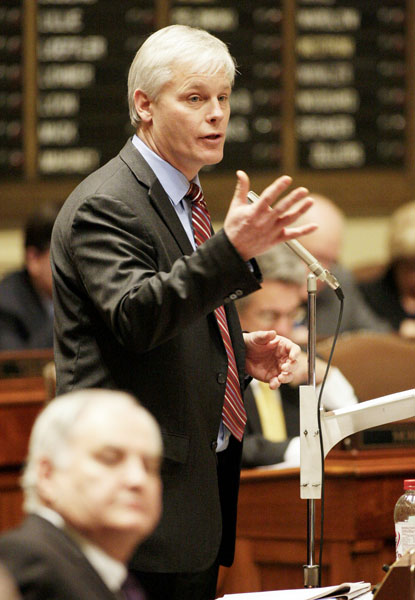
A proposed study comparing compensation for public- and private-sector workers drew criticism from opponents who argued it was flawed and unnecessary.Rep. Keith Downey (R-Edina) sponsors HF2033. As introduced, the bill proposed requiring public employees’ compensation packages to be in line with their private-sector counterparts. Downey successfully amended the bill to scale it down into a nonbinding study comparing public and private salaries and benefits.“The purpose of it is to part the clouds and hopefully answer, once and for all… this overriding question that we always seem to come back with, and this is, ‘Are we fairly compensating our employees here in state government?’” Downey said.The House State Government Finance Committee approved the bill, as amended, on a 12-8 party-line vote. It now moves to the House Ways and Means Committee. There is no Senate companion. Continue Reading
The fiscal notes on which lawmakers rely for estimating the cost of proposed legislation aren’t always transparent and reliable, a new report finds.Fiscal notes are documents produced by state agencies to estimate the financial impact of bills before the Legislature. Since 1974, they have played a key role in the legislative process.In its new report, the Office of the Legislative Auditor finds that while most fiscal notes are based on “plausible assumptions,” many lack transparency. A minority have also been found to contain “debatable assumptions” or outright errors. For example, in one case a simple omission resulted in a fiscal note understating the cost of a bill by as much as $25 million.“Fiscal notes — at least some of them — have gotten a bad reputation,” said Legislative Auditor James Nobles. He and his staff presented the report to members of the House Ways and Means Committee. Continue Reading
The charge that there are too many burdensome laws on the books in Minnesota is one that most legislators are familiar with — whether they agree with it or not. It’s at the core of the debate over the proper size and role of government. But this year, it’s the proliferation of a different type of government power that’s in the crosshairs: the rules created by state agencies. Sponsored by Rep. Doug Wardlow (R-Eagan), HF1831 is designed to undo what its sponsor calls “the soft tyranny of unelected technocrats.” It would require “major rules” from state agencies to come under legislative review before they take effect, and once every two years thereafter. The House Government Operations and Elections Committee approved the bill Jan. Continue Reading
Imagine you’re a business owner, looking to construct a new building on property you’ve owned for many years. You spend several months and tens of thousands of dollars planning it. Finally, you submit your land use application to the city.Then you find out there’s a problem. Someone on the city council doesn’t like your project. They vote to adopt a one-year moratorium on new land uses, and while it’s in effect, they change the land use regulations so that your building can never be built.Does this seem fair to you?Many builders and developers say it’s not, and they’re pushing legislation that would stop local governments from using what they consider underhanded tactics against developers.Sponsored by Rep. Mike Beard (R-Shakopee), HF389 would severely limit the abilities of cities, counties and townships to adopt what are known as “interim ordinances.” Also known as “land use moratoria,” these ordinances allow local governments to unilaterally stop developments from going forward while they rethink their rules for developers.For local governments, interim ordinances help ensure that their communities develop according to a plan, but businesses say they’re often applied in ways that are arbitrary and unfair.The bill had its first hearing Jan. Continue Reading
All lawmakers believe the legislation they sponsor has some value to the public, but Rep. King Banaian (R-St. Cloud) thinks they should have to spell it out in writing.
“If you free up the entrepreneurs, the hard-working women and men of our great state, they’ll build an economy that is sustainable, and we’ll lead the recovery instead of waiting for it to come here,” Zellers said. “Reform 2.0” includes dozens of individual proposals, many of them hatched during face-to-face meetings with business owners. Zellers said he’s hoping that at least some of those ideas are well received by the governor and the DFLers. “We are going to work with the governor; we’ve proven we can work with him on a number of reform initiatives,” Zellers said. Thissen says DFLers can support reform bills as long as they’re not thinly veiled attempts to cut valuable programs and services. “I think you’ll see Democrats embracing good ideas about how to make government work better — as long as it’s about that,” he said. A year for compromise? The other big issue hanging over lawmakers this year, according to proponents, is also a potential job creator: funding for a new Vikings stadium. Dayton is an adamant supporter of a new stadium, arguing it will employ thousands of construction workers, and both Zellers and Thissen say they think a plan to build a new stadium should come up for a vote on the House floor this year. Everyone agrees the clock is ticking. The problem, right now, seems to be the absence of a clear proposal for lawmakers to even consider. “This has to be a good deal on location, it has to be a really good deal on financing … it also has to be good infrastructure,” Zellers said. “Nothing precludes it from happening, but I think a lot of those things need to gel together really quickly.” Thissen said he’s not sure how a vote would pan out on a stadium bill. He said there will likely be some DFLers who would support it and others who reject it. “Whether it goes up or down, I don’t have the answer to that right now. Continue Reading
House and Senate Republicans outlined a new package of government reforms that they say will reduce waste and boost private-sector job growth in Minnesota.The so-called “Reform 2.0” agenda detailed by Republican leaders at a press conference includes dozens of proposals designed to modernize government infrastructure and ease regulatory burdens on businesses. It also includes plans to reform education and health care programs in the state.House Speaker Kurt Zellers (R-Maple Grove) said the “Reform 2.0” plan is the top item on the Republican agenda for the 2012 legislative session.“Minnesotans should know that their government is down here looking at every budget, every spending item, every initiative and every agency as closely as they look at their own budgets,” Zellers said.The House Republican Caucus released a detailed list with more than three-dozen individual reform proposals. A few highlights include:measures to reduce the property tax burden on businesses;proposed legislation establishing mayoral control of city school districts and encouraging charter schools as an alternative to failing public schools;using new technology to combat Medicaid fraud; andestablishing equal pay between government workers and their private-sector counterparts.House Majority Leader Matt Dean (R-Dellwood) said many of the proposals originated from Minnesota residents and business owners during a series of public meetings with lawmakers last year. Dean said the message they took away from those meetings was clear.“They said, ‘We want government to get off our back and out of our way, and we want it to help us,’” Dean said.Some of the included proposals were put forward during last year’s session, but were opposed by Gov. Mark Dayton and DFL lawmakers. In spite of this, Zellers said the Republicans plan to reach out to Dayton in the hopes that some of the measures might find his support. Continue Reading
With some 175,000 Minnesotans still looking for work, DFL legislative leaders and Gov. Mark Dayton held a press conference to unveil their new comprehensive jobs plan.“There are middle-class families struggling to make ends meet,” said House Minority Leader Paul Thissen (DFL-Mpls). “This jobs plan is a collection of a lot of really good ideas.”The package would include $35 million for a $3,000 “New Jobs Tax Credit” to businesses that hire unemployed Minnesotans, veterans or recent graduates in calendar year 2012. After 2012, the credit would fall to $1,500 per new employee and then finally expire at the end of June 2013.Dayton said he hopes to fund the plan partially by closing “corporate tax loopholes,” but added that the overall impact of the plan would be to decrease taxes.The DFLers also proposed a $775 million bonding bill that would focus on infrastructure improvements. Senate Minority Leader Tom Bakk (DFL-Cook) said the package is needed to revitalize the state’s construction industry, which he described as being in a “depression.”“This proposal needs to move early in the session so we don’t lose an entire construction season,” Bakk said.Other elements of the plan include:an “Affiliate Nexus” sales tax on online retailers;$10 million in new funding for the Minnesota Investment Fund;a $4.5 million per year expansion of the FastTRAC job-training program; anda pilot program to provide $2,000 grants to Minnesotans who receive job training in selected fields.Bakk said Minnesota retailers consider the internet sales tax their “No. 1 priority.” Bakk and the DFLers believe it will help level the playing field for brick-and-mortar stores, who are currently at a “competitive disadvantage” with online retailers like Amazon.The legislative session is set to begin Jan. Continue Reading
After holding a series of public meetings around the state, lawmakers, local officials and nonprofit executives agree on one thing: Minnesotans want better, more efficient, cost-effective government.“Overwhelming majorities of Minnesotans made it crystal clear: they believe we really do need to get more for their money,” said Bush Foundation President Peter Hutchinson.Hutchinson and other testifiers briefed House State Government Finance Committee members on the latest efforts toward government reform and redesign. The committee took no action.During the legislative interim, lawmakers have been seeking public input on ways to improve government services. Local officials have hosted their own forums, and nonprofits have conducted public polling on the issue.Reform proponents say Minnesota is transitioning into what they call “the new normal” — an era of perpetual challenges marked by an aging population, a declining tax base and an increasing demand for public services. To cope, they say the state and local governments will have to get creative and learn from the private sector.Jeff Sparks, executive director of the Association of Minnesota Counties, said that redesigning government will necessitate experimentation. He said public officials should look beyond jurisdictional boundaries and embrace innovation, even if it sometimes leads to failures.“Redesign is a goal that we all have, but it can be a goal that can be difficult to achieve,” Sparks said, adding, “When we attempt to innovate, there will be failures.”Beltrami County Administrator Tony Murphy said policymakers need to consider an “outcome-based” approach that emphasizes measurable results and allows officials to collaborate and be creative about problem solving.“Our problem is that we continue to be locked in our silos and our philosophies of service delivery,” Murphy said.Committee members were also briefed on some state-level reform efforts that are already underway. Continue Reading
In what will come as a welcome surprise to many, state budget officials are predicting an $876 million budget surplus for the remainder of the current two-year budget cycle.The state released its November Economic Forecast, projecting a biennial budget surplus for the first time since February 2007. Minnesota Management & Budget Commissioner Jim Schowalter called it “a great respite from the cycles of bad budget news.”“Overall, we still have issues, we still have risks, we still have concerns … but certainly it’s a good day,” Schowalter said.According to the forecast, the surplus stems from higher-than-anticipated revenues near the end of the last budget cycle, along with slower growth in human services spending in both the previous and the current biennia. State Budget Director Margaret Kelly said the savings in human services are coming from slower-than-expected enrollment increases and a number of federal health care policy changes.The long-term picture is not quite as cheery. The state still faces an estimated $1.3 billion budget deficit in the 2014-2015 fiscal biennium — a number that doesn’t account for an estimated $1.3 billion in inflation and more than $2 billion in outstanding K-12 school aid payment shifts.Moreover, the outlook for the U.S. economy as a whole has worsened. State Economist Tom Stinson said the financial crisis in Europe and partisan gridlock in Washington, D.C., have lowered the prospects of significant GDP growth.On the bright side, he said Minnesota is doing better than the nation as a whole.“It’s not that we’re doing as well as we should … but we are outperforming the U.S. economy,” Stinson said.House Speaker Kurt Zellers (R-Maple Grove) said the forecast proves that the Republicans’ agenda of reining in big government is paying off.“This is what happens when there’s fiscal restraint, but also what happens when you reform government,” Zellers said.House Minority Leader Paul Thissen (DFL-Mpls), noting that lawmakers relied heavily on borrowing to balance the state’s budget this year, played down the significance of the surplus.“At the end of the day, it’s good news that we have this money in our savings account, but because we maxed out our credit card, those savings aren’t real,” Thissen said.Under current law, the entire $876 million will be used to replenish the state’s budget reserve and its cash flow account. Continue Reading