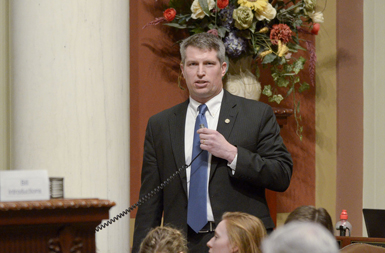
Wanting to go to Washington

Two years ago, Rep. Kurt Bills (R-Rosemount) was teaching economics full-time to teenagers.The freshman representative still starts most weekday mornings talking financial matters in a first-hour advanced placement class at Rosemount High School before spending the rest of his day in or near the State Capitol. However, if things go well this fall, Bills will no longer be teaching in the south suburb or driving to St. Paul.Bills has his sights set on another dome — one in Washington, D.C. He is leaving the Minnesota House in hopes of joining the U.S. Senate.“It’s a great lesson to everybody. No matter what party you are or what is your political ideology, get involved,” Bills said.The change would be a tremendous jump for someone that had not served on a governmental body until elected to the city council in 2008.It was a student asking him what today’s youth should do about the economy that sparked his interest in running for office. “That one kid’s question got me going, and now I’m going to keep going until I’m done, and then I will be an economics teacher again,” he said. Continue Reading

Stadium debate kicks off

An audible was called in the debate for a stadium to house the Minnesota Vikings. Supporters are betting that the change is a winning game plan.However, the backup funding plan has received a less-than-enthusiastic welcome from many legislators and the governor.Nonetheless, the bill has begun to barrel its way toward the goal line.Sponsored by Rep. Morrie Lanning (R-Moorhead), HF2810 calls for a$975 million fixed-roof stadium to be built on the Metrodome site. The team would cover $427 million of construction costs; the state $398 million; and Minneapolis $150 million. The team has played in the downtown Minneapolis stadium since 1982, but team officials say the facility is antiquated and does not provide the needed revenue to remain competitive, nor does it offer a top-notch fan experience.Without much discussion, the House Commerce and Regulatory Reform Committee approved the bill on a split-voice vote April 2 and sent it to the House Rules and Legislative Administration Committee for referral to the House Government Operations and Elections Committee. A number of other committee stops would be necessary before the bill could potentially reach the House floor. Continue Reading

Inmate gardening program proffered in policy bill

Prisoners might be able to grow some of their own food.Part of the omnibus corrections policy bill on its way to the governor is a provision calling for the Corrections Department to establish an inmate gardening program at each correctional facility where space and security allows.Sponsored by Rep. Tony Cornish (R-Vernon Center) and Sen. Warren Limmer (R-Maple Grove), HF2415/ SF2084* was passed 131-0 by the House. The Senate passed it 65-0 March 28.“The produce is to be used for feeding the offenders; excess produce would be donated to food shelves or charities,” said Rep. Glenn Gruenhagen (R-Glencoe), who sponsored this provision in the House as HF467.“Some of the results of this in other states is they see lower recidivism rates with gardening programs, it also saves thousands of dollars — some states save several million dollars — in food costs to the prisoners,” Gruenhagen said, adding inmates have sought a gardening program for many years.Rep. Carly Melin (DFL-Hibbing) said it’s important to teach prisoners skills to help reduce recidivism when they are released. “We’re taking a step in the right direction here.”  Other provisions in the omnibus bill are:victims who would like to be informed when their offender is released from prison or a secure hospital could be notified electronically;allowing the Department of Corrections’ Fugitive Apprehension Unit to apply for a search warrant;barring offenders convicted of murder, manslaughter, criminal sexual conduct, assault, drive-by shooting, assault, robbery, arson and other specified crimes from participating in the Challenge Incarceration Program; andeliminating an annual performance report from the Department of Corrections, instead reverting back to a biennial report. This is expected to save the department approximately $8,000. Continue Reading

Genital mutilation as an enhanced penalty

Within the state’s domestic-violence statutes is a list of offenses that qualify a person for an enhanced offense, potentially leading to a harsher sentence.Sponsored by Rep. Steve Simon (DFL-St. Louis Park), HF2149 would add to that list the crime of female genital mutilation against a family or household member.“Fortunately, it’s rare, but is does occur,” Simon said.Passed 130-0 by the House March 28, it now goes to the Senate, where Sen. Ron Latz (DFL-St. Louis Park) is the sponsor. The bill is based on a July 2011 case in Hopkins where a man held his wife against a wall by her chest and neck during an argument and then threw her to the floor.Following the man’s arrest, the city’s prosecuting attorney reviewed the man’s criminal history to see if he had been previously convicted of a qualified domestic violence-related offense that would have allowed the case to start as a gross misdemeanor, rather than a misdemeanor.Current qualified domestic violence-related offenses include: murder; violating an order for protection, harassment restraining order or no-contact order; stalking; domestic assault; or criminal sexual conduct. None of these was in the man’s past, but he had been convicted of female genital mutilation in 2000, for which he was on probation until 2001. Continue Reading

Synthetic drug deterrence approved

It isn’t easy for law enforcement to keep up with the changing compounds of synthetic drugs, but legislators are again trying to help.Sponsored by Rep. Bob Barrett (R-Shafer), HF2508 would enhance the penalty for selling such substances to a felony, would expand the list of synthetic substances and would grant the Board of Pharmacy expedited rulemaking authority to handle new chemical formulas used by drug producers.“This bill will help keep synthetic drugs — also called designer drugs — out of Minnesota storefronts and off of Minnesota streets by making it more difficult to sell them,” Barrett said. “The goal of this legislation is to help stop this emerging problem before it becomes a larger health crisis like so many other illegal drugs already are, including methamphetamines.”Approved 120-11 by the House, it now goes to the Senate where Sen. Scott Newman (R-Hutchinson) is the sponsor.The bill piggybacks on a 2011 law that added substances known as 2C-E and 2C-I, “plant food,” “bath salts” and synthetic cannabinoids to the Schedule I drugs in the controlled substances chapter of state law; made it a gross misdemeanor to sell synthetic marijuana; and make possession a misdemeanor.While the law had a positive effect in the war on drugs, not all shops are in compliance, instead willing to pay the small fine for a misdemeanor in order to keep doing business. Supporters said making it felonious to sell synthetic drugs will hopefully make some sellers decide what they’re doing isn’t worth the potential price of a $10,000 fine and five years in prison.“Maybe this will get the message across the state that we don’t want one more death in Minnesota as a result of these dangerous drugs,” Barrett said.Rep. Joe Mullery (DFL-Mpls) noted that synthetic drugs can be far more dangerous than the actual product.“While synthetic cannabinoids may seem similar to marijuana, they are nothing like marijuana,” Barrett said. “They are 10 to 100 times more powerful. … These are harsh drugs.” Continue Reading

House passes tougher vulnerable adult, child neglect penalties

People who willingly neglect a vulnerable adult could face a more serious criminal charge. So could those who mistreat a child.Sponsored by Rep. Steve Gottwalt (R-St. Cloud) and Sen. Warren Limmer (R-Maple Grove), HF1945/ SF1586* would create a new felony crime for intentional deprivation of a vulnerable adult, such as with food, clothing, shelter or health care, when the caregiver “is reasonably able to make the necessary provisions.”“Many cases have come to our attention … detailing some of the instances where people have been literally left to rot in their own filth, horrible stories of abuse of vulnerable adults, and up until now we’ve only been able to charge these people with gross misdemeanors,” Gottwalt said.The bill was successfully amended on the House floor March 27 by Rep. Jeanne Poppe (DFL-Austin) to add HF2220, which would reduce the level of harm required for a felony offense for child mistreatment by replacing “substantial bodily harm” in statute with “demonstrable bodily harm.”As amended, the bill was passed 128-4, It now returns to the Senate where the initial bill was passed 64-0 March 19. Gottwalt said the bill is a bipartisan collaboration of many interested parties, including the provider community, law enforcement and prosecutors.The bill provides for three affirmative defenses:the person employed by a facility is unable to “reasonably make the necessary provisions due to inadequate staffing levels, inadequate supervision, or institutional policies”;the defendant operates or manages a facility and did not knowingly or intentionally permit an employee to permit the criminal act; andwhere the caregiver “was acting reasonably and necessarily to provide care to another identified vulnerable adult.”The Poppe-sponsored bill, which stalled in the House Public Safety and Crime Prevention Policy and Finance Committee, is based on a 2011 Mower County case where a 5-year-old child was chained to the slats of his crib every evening. The parents could only be charged with a gross misdemeanor.Because there wasn’t substantial bodily harm, only demonstrable bodily harm — any harm that can be observed by another person — could be used in the charging.“This young boy had bruising, swelling and even a rust stain on his leg,” Poppe said. “What he didn’t have was a broken bone. Continue Reading

Immigrant information sharing couldn’t be prohibited

Rep. Bob Barrett (R-Shafer) said he hopes to help law enforcement do their jobs “without being hampered by city ordinances that conflict with our federal laws.”His bill, HF358, would prevent local units of government from prohibiting their employees from sharing immigration data with federal authorities.“Certainly, one thing we can take away from the tragic events of Sept. 11, 2001, is that communication between the different branches of government is critically important for the security of our citizens, and the lack of communication between jurisdictions results in tragedy,” Barrett said.Approved by the House Judiciary Policy and Finance Committee on a split-voice vote that appeared to be along party lines, the bill was sent to the House floor. It has no Senate companion.“This bill is not anti-immigrant,” Barrett said. “Quite the contrary, this bill supports immigration that happens through the current legal process that our country has had in place for hundreds of years to support immigration to the United States.”A quartet of DFL members spoke against the bill, saying, among other things, that it removes local control, is an unfunded mandate on local government and could create more burdens on the courts because of lawsuits from civil rights actions for being unfairly profiled.“This is just a message bill that doesn’t help solve a problem,’ said Rep. Tina Liebling (DFL-Rochester). She said law enforcement already shares information it deems relevant.Rep. Debra Hilstrom (DFL-Brooklyn Center) said, in theory, the bill would allow a municipal liquor store employee to inquire about a customer’s immigration status without cause.“You’re saying any state employee or local unit of government employee, at any time, whether it’s their job or not, can investigate anybody’s immigration status,” she said. Continue Reading

House passes county attorneys with guns

State statute prohibits local government employees, other than licensed peace officers, from carrying firearms. A few more people could be added to that list.Passed 116-15 by the House, HF1829 would allow a county attorney or assistant county attorney to carry a firearm on duty provided they have a state-issued permit to carry. A county attorney could still restrict an assistant county attorney from carrying while on duty.Rep. Tony Cornish (R-Vernon Center), the bill’s sponsor, emphasized the bill was not a “knee-jerk reaction” of the Dec. 15 Grand Marais incident in which Cook County Attorney Tim Scannell was shot by Daniel Schlienz after the latter was convicted of third-degree criminal sexual conduct, and that it had been brought to him a week before the shooting. However, the incident brought attention to the measure.“Not all county attorneys, maybe not even the majority, will exercise this privilege under this legislation,” Cornish said. He added that there are “a lot of judges that are packing heat under their robes and approve of this also for the county attorney.”The bill would not supersede a judge’s right to ban firearms from their courtroom or courtroom complex.“The concern about security in county courthouses throughout the state remains a very serious problem, particularly the inconsistency,” said Rep. Sheldon Johnson (DFL-St. Continue Reading

House passes enhanced penalty for prosecutor assault

Prosecutors filing a complaint do so on behalf of the state. They are also the ones who must stand up in court and proclaim that a defendant is guilty of a crime and then prove so beyond reasonable doubt. Doing their job sometimes gets them viewed as the cause of all the defendant’s problems and retribution could occur.Added protection from the state could be forthcoming.Sponsored by Rep. Tony Cornish (R-Vernon Center), HF1879 was passed 130-1 by the House Feb. 29. It now goes to the Senate, where Sen. Dave Thompson (R-Lakeville) is the sponsor.The bill would add enhanced penalties for causing the death of or assaulting a prosecutor while that person is engaged in their official duties. Continue Reading