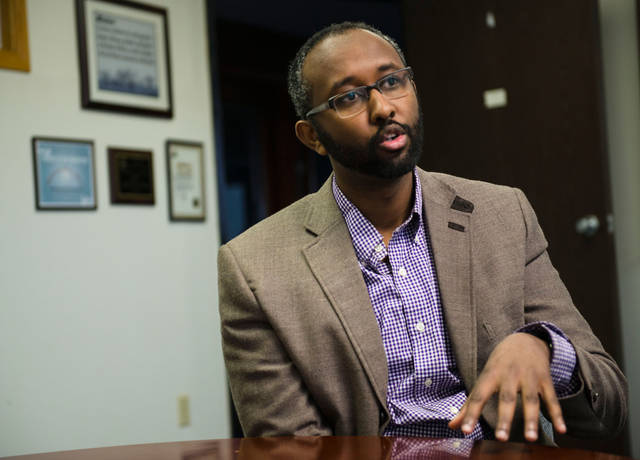
Minnesota is home to the largest Somali population in the U.S. and several members of the Twin Cities Somali community were before the House Rules and Legislative Administration Committee last week seeking support for a resolution denouncing the detention and torture of Somali people in Kenya.
When Oscar-nominated actor Barkhad Abdi took the stage Monday night, the crowd of about 100 that filled Safari Restaurant and Event Center in Minneapolis burst into cheers.
I was browsing around Google News Search when I stumbled on a unique news piece by the Star Tribune talking about a Somali American woman in Willmar, Minnesota, regarding the reunification with her husband who is in Kenya: the news piece is entitled Somali Woman Living in Willmar Can’t Get Her Husband into US . This piece by Star Tribune was reacted to by Power Line (blog) with a meretricious piece entitled The Somali Muddle, Once More Once, written by Scott Johnson, tagged immigration, Islam, Minnesota, in which the story by the Star Tribune of the Somali American Woman was distorted. In the piece, Scott Johnson wrote the following:Today’s Star Tribune features a formulaic story by Randy Furst from the usual heart-tugging angle: “Somali woman living in Willmar can’t get her husband into U.S.” Deep into the story a small dose of reality is permitted to intrude:Then Scott Johnson copied and pasted from the Star Tribune piece the following:A State Department spokeswoman said that “most administrative processing is resolved within 60 days of the visa interview, but the timing can vary based on the individual circumstances of each case.”She said that Somalis are treated the same as applicants from other countries, and more than 1,000 visas were issued to Somalis in the 2013 federal fiscal year, which ended on Sept. 30.“At the same time, we must ensure that applicants do not pose a security risk to the United States and otherwise are eligible for a visa” she said in an e-mail. “Applicants sometimes require additional screening to determine whether they are eligible.”Federal authorities have been concerned about possible links between Somali immigrants to the United States and Al-Shabab, a group that has recruited young Somali men to fight in the Somali civil war. Continue Reading
Kudos to Somali internet media: there are tons of Somali sites simultaneously avowing news about Somalia. The Somali sites have grown into countless numbers to the extent that it is hard to tell or to guess how many of them are really there. There are longstanding and famous sites like Hiiraan Online and the Google News included sites such as Raxanreeb, Somali Current, Midnimo Information Center and others, which have become household names among the Somali Internet community. There are political gossip sites like Waagacusub. You have News sites like Kismaayonews, Allpuntland, Allbanadir, Somalilandpress, Garowe Online and others: the news those sites publish focuses on an area, a city, or a region of local administration in Somalia.Is it really a negative thing that there are too many Somali sites out there? Do the Somali Web users need all these Somali sites with such close similarities, usually slanting things towards 24 hour non-stop news about Somalia?According to the so-called Internet Freedom, a callous freedom towards those ( in parts of Africa, for instance) who lack means to Internet access, what can be easily stated is that people cannot convey their ideas or opinions because among countless factors, one does not live where one can harness the advantages of the Internet, or one lacks the financial means or the knowledge to create a website in line with one`s vision, goals or desires. Continue Reading
When you hear `Somalia`coupled with `piracy ` it rings the bell that Somalia has grown over the years into a household name with sea piracy. But there has been another form of Somali piracy, a Somali music piracy since the downfall of Siad Barre`s military government in 1991. Of course this music piracy can also ring a bell as to what kind of Somali music piracy we are talking about here, where one might think of it as being some kind of online Somali music piracy: but it is more than that. Over the years, I have personally witnessed usually young Somali musicians willing to emerge but using a shortcut to singing by singing old Somali songs of 1970s/1980s and then burning it into new albums/CDs. I am not ranting here to speak evil of the reputation of the emerging Somali musicians but I am trying to shape this writing of mine as a way not only to expose this habit of copy singing but mainly to raise awareness of the issue which I think the Somali music deserves at this modern era when piracy is evolving into forms hard to contain or predict.There is the nickname Wejiya xun coined in Somali for those who shamelessly do copy singing. Continue Reading
A fierce fighting has erupted in South Sudan. It has been in the news for a while now: but there is one thing the war has already achieved: both sides in the conflict are fighting a losing battle. No one will win it. People are getting displaced and this will create refugee crisis. It will send refugee oxidus to neighboring countries. Continue Reading
In this episode, Julia is joined by Ramla Bile to discuss the recent terrorist attack at Westgate Mall in Nairobi, Kenya, its effects on the Somali community in Minnesota, and on media responsibility in covering these issues. [Audio below]
Al-Shabab’s assault on Westgate Mall in Nairobi, Kenya, exemplifies the behavior of a cornered animal — it lashes out when threatened. The tragic paradox of last week’s attack is that recent security gains against Al-Shabab in Somalia have caused the organization to pursue soft targets abroad.