The computer system that handles everything from student registration to payroll at the University of Minnesota is going to run out of product support in December 2014, leaving University officials rushing to upgrade it.
An international collaboration that includes 29 University of Minnesota scientists announced the discovery of a new particle last week that could explain unknown aspects of the universe.The Higgs boson, which scientists theorize gives every particle mass, was observed at the world’s largest particle accelerator, the Large Hadron Collider.They were able to observe the Higgs boson because within the LHC, protons travel at nearly the speed of light and smash into each other — reaching energies comparable to what scientists think occurred during the Big Bang.These energies are measured by the LHC’s calorimeter, which University physics professor Roger Rusack helped design. He also led the group that operated it from 2009-10.Since 1993, the University has been represented in the global group of nearly 4,300 people who discovered the particle, the European Organization for Nuclear Research, or CERN, which is located in Switzerland.Upon returning to the University, Rusack has been teaching, assisting graduate students and doctoral candidates and managing grants for the University group. The technology CERN uses allows him to continue to participate in the effort from Minnesota. After all, CERN scientist Tim Berners-Lee invented the World Wide Web in 1989 to help CERN scientists communicate with one another.Higgs historyIn the 1960s, scientists theorized the existence of an energy field that interacts with every particle. The more particles interact with the field, the greater mass they gain.Peter Higgs wrote a paper proposing that the particle within this energy field could be observed because it would also interact with itself like it interacts with every other particle.Thus, the particle became known as the Higgs boson — its surname coming from Indian scientist Satyendra Nath Bose, who defined “bosons” as a time of particle, according to the Associated Press.Scientists have been searching for the Higgs boson ever since. Continue Reading
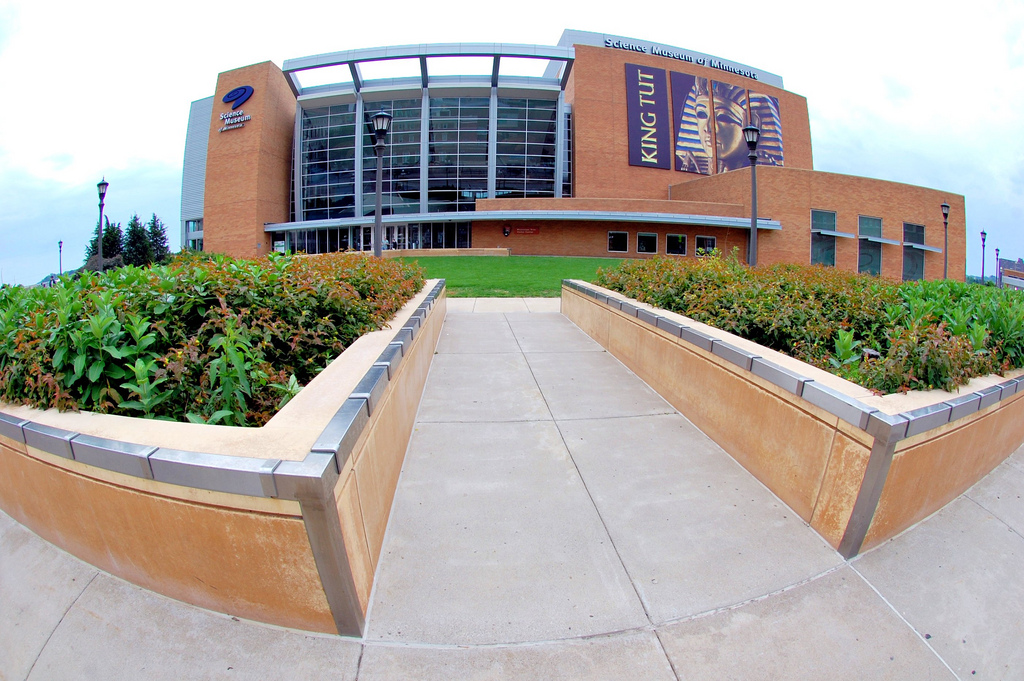
Sometimes even the most lauded art gathering can leave visitors wanting. Thankfully the Science Museum of Minnesota’s monthly lecture series “Beaker and Brush” perfectly fills this void.
Thanks to Ann Higgins for the heads up on a recent article in the Brainerd Dispatch that fits in so well with a recent Blandin Foundation Pre-Conference webinar.
This past Friday, The University of Minnesota’s Broadband Access Project held a free two part training session on Quick Books for Saint Paul Public Housing at the Asian Community Technology Center.
At the end of a fun summer Saturday, just before Father’s Day, my son and I sat ourselves down and decided to see what was on teevee. There, on the Science Channel, was just what we were hoping for – the RoboGames with Grant Imahara of Mythbusters fame. It’s a competition of remote controlled devices that thrash, rip, and somet Continue Reading
If you went to Nicole Anderson’s Facebook page on a Friday evening, you’d most likely be able to tell where she was. Anderson, a psychology senior, frequently uses the “check-in” application on her phone, allowing it to access her location and post it on her page.Anderson chooses to use check-in, but not everyone wants their whereabouts posted.Users of any Apple device — like an iPhone or iPad — with a recently upgraded system have had their location tracked automatically for up to a year without their permission.The upgrade came out a few days before the iPhone 4 in June 2010. Data showing the devices’ tracking records was released by security researchers two weeks ago.For Sen. Al Franken, D-Minn., this is a serious and dangerous violation of privacy. As chairman of the Privacy, Technology and the Law Senate Judiciary Subcommittee, Franken will hold a hearing May 10 on the issue. Representatives from Apple and Google, which has a similar operating system in its Android phones, will be testifying at the hearing.Franken recently sent a letter to Apple CEO Steve Jobs about his company’s most recent operating system. Continue Reading
Protecting your identity is important and with Wi-Fi networks popping up nearly everywhere, many consumers don’t realize the dangers that come with using a Wi-Fi connection that is not their own. According to a recent poll conducted by Wakefield Research and Wi-Fi Alliance, 32 percent of respondents said they have tried to get on a Wi-Fi network that was not their own, a startling 18 percent more than a December 2008 poll. The Better Business Bureau of Minnesota and North Dakota (BBB), along with the Federal Trade Commission (FTC), urges consumers to think ahead before surfing the Web on a Wi-Fi hotspot. Free Speech ZoneThe Free Speech Zone offers a space for contributions from readers, without editing by the TC Daily Planet. This is an open forum for articles that otherwise might not find a place for publication, including news articles, opinion columns, announcements and even a few press releases. Continue Reading

 Technology and education seem to be big topics this week – today I read an