Drug courts: An alternative to the war on drugs?

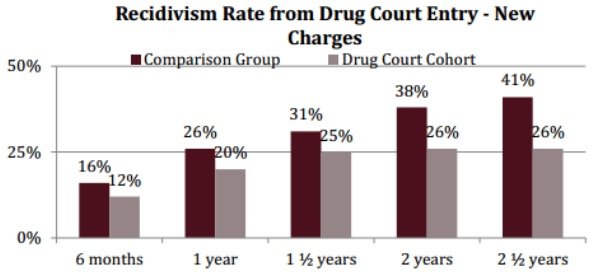
Miami built their first drug court almost 25 years ago as an alternative way to combat the rapid increase in cocaine-related crimes. It worked so well that by 1996, Minnesota followed suit, and now the state is expanding the program.Following a 2013 Minnesota Legislature funding increase, the Minnesota Judicial Council authorized the addition of six new drug courts in Minnesota last month, bringing the state’s total number to 44 courts serving 56 counties. And officials say the addition will help keep offenders from falling back into the system and save the state money when compared to traditional incarceration.“What [the researchers] found was if someone was sentenced to treatment [by a traditional court], most defendants didn’t even show up, and the ones who did dropped out,” said state drug court coordinator Jim Eberspacher. “If you don’t supervise the person and continue to provide services, the likelihood of them continuing down a path to sobriety is minimal.  Drug courts attempt to provide all the services necessary to keep the person on the right path.”A 2012 state-wide evaluation compared 500 drug court participants to nearly 650 similar offenders who did not participate in the drug court program. Over the two and a half year study, drug court participants had a 17 percent recidivism rate compared to 32 percent of those who didn’t participate – almost a 50 percent reduction. Continue Reading

State Services for the Blind reaches out to people of color

Over many years, studies have shown African Americans to be more prone to diabetes than Caucasians and to have a higher incidence of diabetes-related vision loss or impairment. The Minnesota State Services for the Blind, a relatively little-known State agency, can help people of color with vision loss or visual impairment, whether diabetes-related or from other causes.

Continue Reading

Whose country is this?

There were many disadvantages to being brought up in a restrictive part of the country in the 40’s and 50’s, even if you were white and middle class. In my mother’s New England, in the broken land and stunning autumn months and soft spring times of my childhood, I was told, in words and gestures from both teachers and parents that I had only a limited role to fill in this world. In my privileged home, oldest of five children, it was assumed that marriage would define me and that it was indeed unseemly of me to want more. I was not denied the chance to explore the world around me, to go on those long hikes I have written about or swim in dangerous water. At the same time I was expected to settle down, and to content myself raising a large family. My mother did not work. I would not work. Continue Reading

Youth, sports, and life

It is hard for me to become enamored with sports where the only scoring is penalty kicks or multiple overtimes. But watching what I have of the World Cup has been an education. A lot of people want to guide kids who might play American football into soccer, but the World Cup shows that the image of “safe sport” is an illusion. Not many kids who play American football end their season with cracked vertebrae like the leading scorer for Brazil. I’m sure our football beats the brain up worse than soccer, but the excessive use of the head for ball movement in soccer can’t be particularly good for the brain either. Continue Reading

Five votes. Five Catholics. Five men. What is wrong with the Hobby Lobby decision?

Five votes. Five Catholics. Five men. One decision. Potentially millions of American women denied contraceptive coverage. This what the recent Hobby Lobby decision is about, but it also reveals three deeper problems–the sexism pervading the current Supreme Court along with its religious parochialism, a serious problem with the role that religion has come to occupy in American society, and the elevation of corporate rights and power that is strangling American society. Continue Reading