Minneapolis attorney Steve Kaplan helps to free death row inmate Damon Thibodeaux, who had been wrongly convicted of rape and murder

For more than a century, juries in criminal cases in the United States have been instructed that defendants are entitled to the “presumption of innocence”: The state has the responsibility to prove that a person accused of a crime is guilty beyond a reasonable doubt.The presumption of innocence is derived from writings that go back to the Bible and to Maimonides, who wrote in the 12th century that “it is better and more satisfactory to acquit a thousand guilty persons than to put a single innocent one to death.”English jurist William Blackstone updated this concept, in the 18th century, when he wrote that it is “better that 10 guilty persons escape than that one innocent suffer.”In practice, however, the innocent sometimes are ensnared by a criminal justice system that goes off the rails. Such was the case with Damon Thibodeaux, a Mississippi River workboat deckhand from Texas, who traveled to New Orleans to attend two family weddings. When his 14-year-old step-cousin, Crystal Champagne, was found murdered in July 1996, police brought in Thibodeaux for a lengthy interrogation.After nine hours of police grilling, and going without sleep for more than 30 hours, Thibodeaux cracked and falsely confessed to committing rape and murder.Recalling the police interrogation, Thibodeaux said, “At first it was just routine, but as the night goes on, things progressed to a point where you realize that, look, they’re never going to let you go, and it’s either you give them what they want or they’re just going to keep at it.”The American Jewish World recently conducted a lengthy interview with Thibodeaux and Steven Z. Kaplan, a litigator with the Fredrikson & Byron firm. The interview took place in a conference room at the firm’s offices on the 40th floor of U.S. Bank Plaza in downtown Minneapolis.Kaplan served as the lead lawyer for Fredrikson & Byron’s pro bono work on Thibodeaux’s case. He and other lawyers from the firm worked in partnership with Barry Scheck and his associates with the Innocence Project; Denny LeBoeuf, of the ACLU Capital Punishment Project and the Capital Post-Conviction Project of Louisiana; and Caroline Tillman, also formerly with the Capital Post-Conviction Project of Louisiana.In 1997, Thibodeaux was brought to court. Continue Reading

Federal court hearing turns Talmudic in the case of Hebrew National

During a St. Paul federal court hearing last Friday, on a motion to dismiss the lawsuit alleging that Hebrew National’s hot dogs are not kosher, pages of Talmud were projected onto video screens.Corey Gordon, the lead lawyer for the defendant, ConAgra Foods, Inc., the corporate owner of Hebrew National, cited passages from the Torah; and mentioned Rashi, the medieval Talmud commentator, along with Torah sage Moses Maimonides, the Rambam.Judge Donovan W. Frank, the U.S. District Court judge presiding over the case, addressed the lawyers at the outset of the two-hour hearing: “Either there are two lawsuits or you are misstating the case,” in reference to the disparate arguments being made.The judge also held up a massive three-ring binder, more than a half-foot thick, and noted that the legal combatants had submitted thorough briefs in the case. Frank, who mentioned that he had read all of the materials and looked at various Web sites, said that he would issue a decision about the motion to dismiss the lawsuit within 60 days of the hearing.The 11 plaintiffs in the putative class action lawsuit charge ConAgra Foods with negligence, violating consumer protection laws and breach of contract, for deceptively marketing Hebrew National products as “strictly 100% kosher” and charging a premium price for the products.However, Gordon, of the Blackwell Burke law firm in Minneapolis, contended that ruling on the plaintiffs’ claims would thrust the court into determining religious standards, which it is barred from doing by the Establishment clause of the First Amendment.“The singular issue in this case is whether Hebrew National hot dogs have been fraudulently marketed to the public as kosher,” Gordon told the court. “There is no secular concept of kosher… it is inherently, intrinsically a religious issue.”Judge Frank, who summarized the legal issues and questioned the lawyers throughout the Nov. 30 hearing, suggested to Gordon that the plaintiffs were saying that procedures were not followed, and that “the fraud is that they’re not doing what they say they’re doing,” regarding their treatment of workers, establishing a quota system for approving a certain percentage of cows as kosher, and other issues.Gordon responded — “as a Jew and the grandson of a kosher butcher myself” — that the laws of kashrut are not “a few straightforward rules,” as the plaintiffs contend. Continue Reading

OPINION | Israel and Hamas bring the pain

Israel is at war with Hamas, again. You can spend all day reading news reports and commentaries — and wind up pretty disheartened and depressed. However, residing more than 6,000 miles from the war zone certainly has its advantages, as far as being out of mortar and rocket range.

Continue Reading

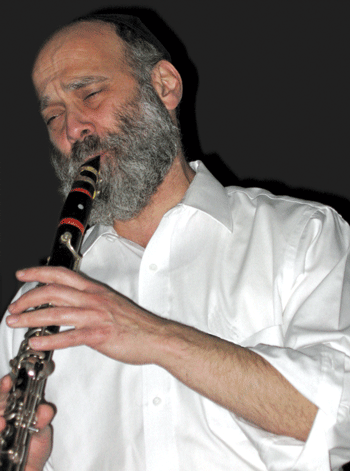
Andy Statman, a master on both clarinet and mandolin, will perform Dec. 2 at the Cedar Cultural Center

Andy Statman, a musician’s musician, who has played with everyone from Bob Dylan to Itzhak Perlman, returns to Minneapolis for a rare concert appearance Dec. 2. He will pack his mandolin and clarinet, and schlep from his home in Brooklyn for the show at the Cedar Cultural Center, the music hub on the U of M West Bank.

Continue Reading

A poet from the Jewish state: Israeli superstar David Broza returns after long absence for a Nov. 11 show at the Dakota Jazz Club

Israeli singer-songwriter David Broza has not played the Twin Cities in nearly 10 years. His last show here was part of the 2003 “Heartbeat of Israel” series, originated by former Minneapolis-area shaliach Itai Tenenbaum (itaitours.com).Broza, a certifiable superstar in the Jewish state, will return to the North Country for a Nov. 11 performance at the Dakota Jazz Club in downtown Minneapolis. Don’t miss it — the chance to hear the renowned singer and guitarist might not come again for another decade.I last saw Broza in concert in 2008, at the Eliav-Sartawi Awards for Middle Eastern Journalism, an event in Jerusalem sponsored by the Washington, D.C.-based group Search for Common Ground. The troubadour was the featured performer, and Wa’alat, a talented band of Arab Israeli musicians opened the show, then later joined Broza for a closing number.Last week Broza talked to the Jewish World by phone from his home in New York City, and the conversation ranged over his poetic influences, being branded the “Bob Dylan of Israel” and his current projects. Continue Reading

OPINION | Beyond the elections

The October issue of The Atlantic magazine included a number of articles billed under the general theme: “You call this an election?” The stories deal with the corrupting flood of money that has poured into election campaigns; how congressional districts are gerrymandered to get certain partisan results; and the recent history of “anti-voter fraud” efforts, which have targeted black and Hispanic neighborhoods in order to intimidate the voters in those precincts.On the financing issue, James Bennet asserts, in his article, “The New Price of American Politics ,” that the “growing river of anonymous money [from Super PACs] is a result of the brokenness of our political system; no branch of government made an affirmative decision to let this money in. If it chose, the IRS could demand that the politicking social-welfare nonprofits, as well as business associations like the Chamber of Commerce, disclose their secret donors.”Bennet mentions that Senate Republicans filibustered the Disclose Act, which “aimed to compel groups to name the big contributors behind political advertising.” He adds that in the infamous Citizens United case, eight of the U.S. Supreme Court justices favored disclosure.So, citizens of this country will go to the polls on Nov. 6, and cast their votes, as a tidal wave of money from billionaires and corporations has been poured into electoral campaigns to skew the results. However, our votes could still make a difference in some electoral contests:In Minnesota, Republicans in the Legislature put two measures on the ballot this year, which would change our state constitution. They are both very bad proposals.The voter ID measure, which would require voters to show a government-issued photo ID in order to vote, has a certain common sense appeal, but it is essentially a solution to no problem. Continue Reading