.JPG)
St. Paul energy efficiency drive kicks off with May 25 workshop
|
A program aimed at helping St. Paul residents in some neighborhoods cut their home energy bills is going city-wide.
Twin Cities Daily Planet (https://www.tcdailyplanet.net/author/lawrence-schumacher/page/3/)
A program aimed at helping St. Paul residents in some neighborhoods cut their home energy bills is going city-wide.

The one thing you can say in favor of the legislative session that just wrapped up is: it could have been longer. At least DFL and Republican lawmakers didn’t charge the people of Minnesota much in the way of extra salary for the privilege of:
Making school districts take out payday loans to stay in business. Making cities and counties cut services and raise your property taxes. Failing to put a dent in a looming 2011-2012 state budget deficit. Missing out on federal dollars for education and health care that could have helped reduce that deficit. Continue Reading

In the last week, Gov. Tim Pawlenty has killed seven bills with the swipe of his veto pen, with the promise of more to come as the session ticks down toward its close Monday.Pawlenty has said he’ll veto bills allowing surviving domestic partners to claim their deceased loved one’s remains and a state pensions overhaul bill that Pawlenty said doesn’t cut costs enough.The first bill doesn’t have the votes for an override, but the second did and enjoyed significant Republican support.Since Pawlenty fancies himself the “state’s goalie,” blocking shots from the DFL Legislature he says would make Minnesota a worse place to live, let’s take a look at the pucks he’s already stopped this week:* HF 2037 from Rep. Loren Solberg, DFL-Grand Rapids, and Sen. Richard Cohen, DFL-St. Paul, would have eliminated the state’s $3 billion budget deficit through K-12 payment shifts, state aid and health and human services cuts, and by creating a fourth-tier income tax bracket.The bill passed with only one vote to spare in the Senate, and Pawlenty said in his veto message that he opposed the new top income tax bracket and all tax increases to solve the deficit.* HF 2614 from Rep. Tom Huntley, DFL-Duluth, and Sen. Linda Berglin, DFL-Minneapolis, was the omnibus health and human services bill. It would have cut $114 million in HHS spending and signed Minnesota up for the early federal Medicaid expansion program to replace the state’s General Assistance Medical Care program.The bill did not get a veto-proof majority in the House of Representatives, and Pawlenty said in his veto message that the bill didn’t cut enough spending and would have put in place new surcharges to pay for expanded care.* SF 915 from Sen. Scott Dibble, DFL-Minneapolis, and Rep. Larry Hosch, DFL-St. Joseph, would have required school district employees to buy into a statewide public health insurance pool.This bill didn’t have a veto-proof majority, and Pawlenty said in his veto message that the bill would remove local control from school districts while not addressing inflationary health care costs.* SF 2790 from Sen. Mee Moua, DFL-St. Paul, and Rep. John Lesch, DFL-St. Continue Reading

UPDATE: Both amendments failed miserably, with only 20 votes in favor of each. Arguments that police don’t abuse the forfeiture system, that the state would rob local governments of the money, won the day.Efforts to keep a better eye on law enforcement agencies and their practices at the Legislature this year so far haven’t included any serious efforts at reducing their dependence on forfeitures and seizures.Even though the Legislature is on the verge of passing a bill to prevent multi-jurisdictional agencies from going rogue like the Metro Gang Strike Force did last year, a bill on property forfeitures headed for a vote Thursday in the Minnesota House of Representatives does little to restrict law enforcement agencies’ ability to take, keep and profit off of property seized from law-abiding citizens.That could change, if two controversial amendments from Rep. Tina Liebling, DFL-Rochester, get added to the bill on the floor. One would require law enforcement agencies to give back forfeited property if there’s no criminal conviction. Another would require local agencies to contribute the money from the sale of seized property to a statewide law enforcement fund instead of keeping it local.Both amendments are opposed by Rep. Joe Mullery, DFL-Minneapolis, the bill’s author and chair of the House Civil Justice Committee. Also opposing them are most of the state’s law enforcement lobby groups, such as the Minnesota Chiefs of Police Association.Interestingly, three board members on the MCPA were also serving on the Metro Gang Strike Force Advisory Board when that now-defunct agency went off the rails, yet they’re arguing that there are already enough audits and controls in place to prevent abuse.In 2007, law enforcement agencies statewide made more than 5,000 seizures and gained almost $5 million in revenue from them, double the proceeds from just a decade ago.Liebling argues that it’s a conflict of interest for police departments to make money off taking people’s property, and that they shouldn’t be able to “eat what they kill” when it comes to keeping the profits.A similar forfeiture bill from Sen. Mee Moua, DFL-St. Paul, already passed the Minnesota Senate without the language to discourage forfeitures.Ironically, if the amendments do pass, it will likely be due to help from Republicans in the House minority, according to the Rochester Post-Bulletin. Continue Reading

Survivors of deceased domestic partners would soon have the power to inherit their partners’ remains, if Gov. Tim Pawlenty signs a bill headed his way in the closing days of the legislative session.SF 341 from Rep. Erin Murphy, DFL-St. Paul, and Sen. Yvonne Prettner Solon, DFL-Duluth, passed the Minnesota House of Representatives 78-55 on Tuesday and the Minnesota Senate 41-24 on Wednesday and is headed to Pawlenty for his signature.The bill would write domestic partners into Minnesota law for the first time and give them legal status when it comes to inheriting remains and suing the state in the event of a wrongful death claim.Murphy said the bill repeals two of 515 provisions in Minnesota law that discriminate against committed couples.The House vote comes on the same day that three same-sex couples filed a lawsuit challenging Minnesota’s marriage laws, which require a marriage to be between one man and one woman.Pawlenty’s spokeman, Brian McClung, told Minnesota Public Radio that the bill was “unnecessary and seems to be a political exercise to get the term ‘domestic partner’ into state law,” raising the possibility that Pawlenty, a likely 2012 Republican presidential hopeful, would veto the bill.Republicans accused DFLers of bringing the socially controversial bill to the floor to distract attention from the state’s $3 billion budget deficit, but Murphy said repealing discriminatory laws shouldn’t be controversial.Several rural DFLers voted against the measure, leaving it well short of the number of votes required to overturn a Pawlenty veto, if it comes. Continue Reading

UPDATE: We didn’t have long to wait. The veto has arrived. Go here to read it. Groundhog Day. The definition of insanity. Continue Reading

DFL leaders in the Minnesota Legislature on Monday unveiled a budget deficit-erasing bill that gives Gov. Tim Pawlenty most of what he wanted, but will still probably get him to pick up his veto pen.
HF 2037 from Rep. Loren Solberg, DFL-Grand Rapids, is moving fast through both the Minnesota House of Representatives and Senate Monday, and could be on its way to Pawlenty’s desk by the time you read this. The bill would ratify most of the $2.7 billion in unallotment cuts Pawlenty made last year, including $1.75 billion in K-12 education payment shifts that will cost local school districts money, even though the Minnesota Supreme Court last week decided Pawlenty had gone beyond the law in making those cuts. Check the spreadsheet out here for the blow-by-blow accounting. Minnesota Budget Bites has an analysis here. That includes $100 million in cuts to higher education that will drive up tuition and put college out of reach for more Minnesotans, and $150 million in cuts to programs that serve the poorest, most disadvantaged Minnesotans. Continue Reading

Want a list of reasons why our elected leaders won’t solve the state’s budget deficit by May 17 like they were supposed to? Let’s count the ways in which they will fail:1) Tim Pawlenty is running for the Republican nomination for President, and he can’t sign any bill into law that includes new revenues to help the state out of its budget deficit.2) DFL lawmakers won’t agree to ratify all of Pawlenty’s unallotment cuts unless every Republican in the Senate and House of Representatives votes for them, and they won’t because taking direct responsibility for those cuts would kill their chances in November.3) Republican lawmakers have every incentive to make the DFL leadership look like it can’t get anything done and no incentive to help fix the mess as they go into the November elections.4) DFL lawmakers won’t agree to a budget deal that doesn’t include new revenues because they’d have agreed to hurt the poorest and most vulnerable Minnesotans while leaving the wealthiest untouched. Incompatible with reason 1.5) $408 million in enhanced Medicaid matching funds won’t be approved at the federal level before the Legislature adjourns, yet the money is essential to any budget deal.6) Nobody really knows for sure how big the budget deficit is anymore, since the MN Supreme Court ruled Pawlenty’s unallotment actions did not follow the law. A best estimate from Minnesota Budget Bites is that there’s still $700 million to cover, if the Legislature agrees to ratify Pawlenty’s delayed payments to K-12 school districts, but it’s still not clear how much of his $2.7 billion got wiped out in the court decision.7) The House may be prepared to go along with that K-12 shift, but the DFL Senate under Larry Pogemiller, DFL-Minneapolis, shows no signs of agreeing to any of Pawlenty’s actions from last year. That shift represents $1.8 billion.8) House Speaker Margaret Anderson Kelliher, DFL-Minneapolis, is the DFL Party’s endorsed candidate for governor, and won’t be able to reprise her past role as the sane, rational adult in the room when she and Pawlenty and Pogemiller meet to find an agreement. Continue Reading

After a House committee voted 10-9 Wednesday against a proposed Vikings stadium finance bill, many are writing early obituaries for this latest public handout request.But let’s not be too hasty to dance on its grave yet, shall we?Take a closer look at what’s in the bill and you’ll see how stadium backers might still find enough carrots to get them to a majority before this is over.But first, let’s look at why the stadium bill is on life support.Gov. Tim Pawlenty said he won’t sign any bill with a tax increase in it. So portions of the bill, from Rep. Loren Solberg, DFL-Grand Rapids, that raised money through a tax on sports jerseys and memorabilia, lodging taxes and rental car taxes had to go.But that effectively removes every location option for building a new $791 million stadium except for one — Minneapolis. The other funding provision in the bill would allow Minneapolis to divert local taxes already in place for its Convention Center to pay for the new stadium in 10 years, after the Convention Center debt is paid off.Problem is, Minneapolis isn’t too thrilled about giving up that revenue for the Convention Center, and doesn’t think it should have to pay all the public cost of a stadium that will be used by people from all over the state. City Council member Elizabeth Glidden said as much Wednesday in committee.So how to win over Minneapolis? How about letting the city throw some funds at the financially ailing Target Center? Continue Reading
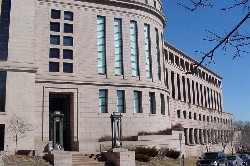
In a 4-3 ruling delivered Wednesday, the Minnesota Supreme Court essentially rejected $2.7 billion in unilateral spending cuts Gov. Tim Pawlenty made last year after he vetoed a tax bill that would have raised that amount at the end of the session.
Chief Justice Eric Magnuson, a Pawlenty appointee who’s retiring this June, along with Justices Alan Page, Paul Anderson and Helen Meyer, decided Pawlenty did not follow the law when it came to unalloting more than $5.3 million in approved spending for Minnesota’s Special Diet Program.