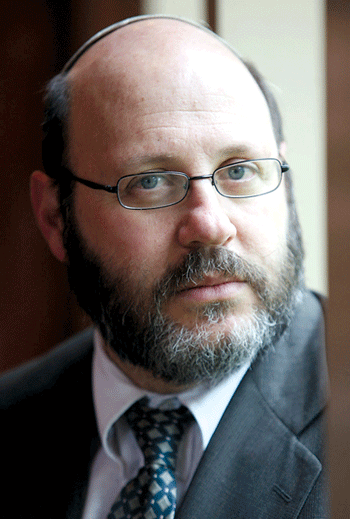
For more than a month, 20 entrepreneurs from four Middle East countries lived and worked together in the Twin Cities. For the second year, Hamline University’s Education to Employment Fellowship Exchange Project — funded by a grant from the U.S. State Department — provided valuable business training to fellows who want to contribute to the economic development of their home communities.The fellows, who came from Israel, Jordan, Lebanon and the Palestinian Authority, were recruited for their demonstrated leadership potential, after national searches were conducted with the assistance of the local cultural attaché offices of the U.S. Embassy. The 20 fellows have diverse backgrounds, and included mid-level administrators, community activists, journalists, scientists and nurses who were in Minnesota from May 14 to June 16.Four Education to Employment fellows, including Arie Bornstein (far right), work on their business plans during a recent workshop at Hamline University in St. Paul. (Photo: Erin Elliott Bryan)According to a press release, the program recognizes that conflicts and violence are “byproducts of a lack of economic opportunity.” The project’s overall hope is that “through practical training, private enterprise initiatives and constructive business leadership, job opportunities will grow in the aforementioned communities, political tensions will subside and a more hospitable environment will emerge to accommodate cultural, religious and ethnic differences, and nurture pluralism.”Hamline University has teamed up with business partners in Minnesota to instruct the fellows in formal and informal settings. Continue Reading