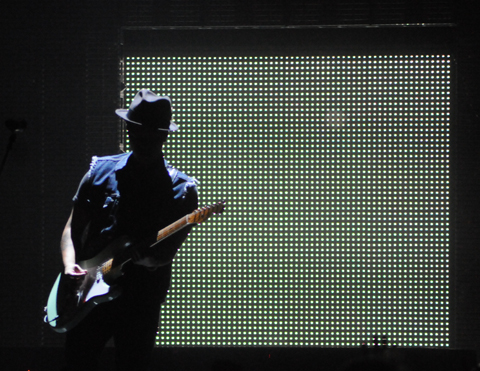
 Andrea Swensson at City Pages has just written about an issue I’ve been meaning to address as well: the increasingly oppressive contracts national touring acts are asking photographers to sign before being granted access to photograph their shows. The provisions Andrea describes Foo Fighters demanding are increasingly common: acts requiring approval of all photos prior to publication and, further, demanding permission to republish the photos for their own purposes, in perpetuity, without payment or credit. Oh, and the photographer can publish the photos only in the designated publication—not even on a portfolio website.
City Pages and their photographer Erik Hess refused to cooperate, and so City Pages‘ coverage was published without photos. Apparently Foo Fighters have negotiated with other publications, but the fact that they were willing to say sayonara to the photographer from City Pages—one of the three biggest sources of concert coverage in the Twin Cities, along with the two daily newspapers—is telling, and shows how confident bands are that they can get away with playing hardball in determining the terms of concert coverage right now. Andrea’s right, I think, in speculating that bands requiring approval of reviews would be the next step.
Why are bands doing this?
| Update 9/19/2011: This post was originally written and published on September 15. We’ve had a lot of response and feedback from our readers, and after discussion among our staff, we have set a policy: moving forward, the Twin Cities Daily Planet will not publish photos that have been submitted for approval by their subjects. We intend to continue discussing this important issue; later this week, editor Mary Turck will be writing about this topic, and we’ll be inviting photographers and other interested community members to share their views. – J.G. |
One question Andrea doesn’t address is the question of why: why now? It’s not like bands are suddenly concerned about their image in a way they weren’t previously. You can bet that Colonel Parker would have taken the heads of reporters who wanted to cover Elvis and put them in vises if he thought he could get away with it. It seems that in the last couple of years, bands feel that they have a stronger hand to play in negotiating press access.
I’d speculate that it’s changes in the media and technological landscape that are making bands both more wary and more bold.
Think back just 20 years ago, before photography went digital; then, the Internet was little more than a curiosity for the average Joe. The equipment required to take decent photos of a low-light, fast-moving concert was several times more expensive than it is now: instead of $2,000, think $10,000-$20,000. Plus, the equipment was harder to use and feedback wasn’t instant, so you needed a lot more experience to use it well. Then there was the cost of film, the need to process the photos quickly, and the need to publish and distribute some sort of physical publication for the photos to be seen.
The number of players in an average media market who were on that level was very limited—and they were known entities. In the Twin Cities, the daily papers probably would have sent staff photographers; for a really big show, a handful of other newspapers, magazines, and TV stations might have come out of the woodwork. What could, and would, happen with those photos was fairly predictable—and the bands badly needed the local print coverage, because with no Internet, marketing themselves independently was hugely expensive.
Fast-forward to 2011. Even the tiniest bands can reach fans around the world, instantly. When they come to town, the number of media players they’re dealing with has—I imagine—increased exponentially. The dailies are still around, and so are alt-weeklies like City Pages—but now there’s an entire second layer of edited online publications like the Daily Planet, and a vast unedited blogosphere. It would take me more fingers and toes than I have on my body to count all the local publications that can make credible claim to publish serious (albeit occasional), quality coverage of live music. So the bands need us less—and there are more of us who need them.
Then, there’s the question of who’s doing the photography. There are still a precious few staff photographers working for a few local publications, but more and more print photography—and almost all online photography—is done by independent freelancers. Many publications, like the Daily Planet, don’t even pay concert photographers. Why? Because we don’t have the money. If we had to pay for live music photography, we just wouldn’t have any, period. Knowing that, a large number of very talented photographers still choose to donate their time and their skill—in part because they support our mission, but in large part because they then get access to concerts for which they’d otherwise need to buy a ticket and not photograph. When it works, it’s a win-win-win situation for the publication (we get the coverage), the photographer (they get the access and the experience), and the band (they get the publicity).
All the photographers we work with are principled individuals who are not out to exploit these opportunities for unfair personal gain or to the detriment of a band—but there are a lot more people taking concert photos now, with much more diverse motives, than was formerly the case. I can only guess that at the Foo Fighters’ level, they’ve encountered some very bad eggs—and, accordingly, feel the need to exercise greater control over what happens to photos of them.
One example: Ke$ha
So what’s happened is that access to concert photo pits has become a seller’s market. Here’s a concrete example of where we’re at.
When Ke$ha came to town a couple of weeks ago, her people notified press that they’d have to sign a contract comparable to the Foo Fighters’: approval required, ownership of photos taken. The Daily Planet was not among the publications granted access—meaning that Ke$ha had no trouble filling her photo pit with compliant photographers from bigger publications. She didn’t need us, and apparently the Foo Fighters don’t even need City Pages. So right now, no wonder bands feel free to impose those conditions. Manifestly, they can.
So what happens next? I was part of a heated Twitter debate over the Ke$ha show, with multiple independent photographers expressing anger over the conditions Ke$ha was imposing, and at least one freelance photographer explicitly imploring me not to sign the contract. A general sentiment seemed to be that the media need to band together and put our collective feet down in protest of this practice.
Will that happen? Possibly. Apparently Janet Jackson changed her contract after a number of important media outlets declined to sign, and the Foo Fighters might be coerced into doing something similar if enough publications follow City Pages‘ lead. But media have already let the line slip into, as Andrea accurately notes, editorial independence: the Daily Planet agreed to one of these contracts for Tiësto, and we notified our readers that the photos they were seeing were only those that Tiësto had approved. The review/photos landed hundreds of hits; the vast majority of readers manifestly didn’t punish us for making that call.
If Ke$ha had granted access, I would have signed that contract and taken those photos myself. That’s a different call than City Pages made with Foo Fighters, and one that would have disappointed a number of my photographer friends.
Why? I don’t think the current situation is ideal, but it’s the reality we’re currently facing. If Ke$ha demanded approval of my review, I probably wouldn’t sign—but if she wants to own my photos? Sure. I’m nowhere near as good a photographer as Erik, so I have no hope of making a living at photography; for me, it would be fun just to get in and see the show, and my photos would not be great, but they’d be good enough. And there are hundreds, probably thousands, more like me: if I told Ke$ha no, plenty of eager bloggers would jump right up on that stool with their own $2,000 DSLRs.
And what if Ke$ha does find herself looking down at a bunch of blogging volunteers instead of a corps of paid professionals? Would she care that their coverage would be lower-quality? Well, maybe. Right now, she’s getting away with these conditions because she can, and until the Ke$has and Foo Fighters start turning the screws even harder, I don’t see the market forces that allow them to get away with this changing. Under these circumstances, I’m not going to throw myself under the bus for a lost cause.
The big picture
I’m pessimistic about the medium-term prospects for publications to be able to demand greater rights in the photo pit, but I certainly agree that this is an important issue—and it’s a much, much bigger issue than just whether or not independent photographers retain ownership of their Ke$ha photos.
The changes in the media landscape that are empowering bands to drive harder bargains for media who want access are causing change in all news coverage. There’s much more news coverage now, of everything: there are more publications, and less money. Less money means, on the one hand, less independence: if a greater proportion of journalists aren’t paid to be independent journalists, that means they have less time and are more beholden to work that’s done for them by publicists and other interested parties.
Plus, journalists are more likely to be interested parties. If you’re not making money at journalism, you’re making money at something else—which is, more likely than not, at least somewhat related to what you’re writing about. Readers online are demonstrating that they either don’t know or don’t care that this is happening, because they read independent—sometimes outright partisan—publications that have nothing like the traditional conflict-of-interest policies that formerly governed journalism.
Many observers think this is a dark development. In some ways, it is—but at the Daily Planet, we’re trying to amplify the silver lining. We don’t have a conflict-of-interest policy, we have a transparency policy: we ask our contributors to declare what, if any, their involvement with a story is. Readers can decide for themselves whether that makes a story more or less valuable—or both, in different ways.
Ironically, with that policy comes a form of independence that traditional journalists didn’t have: instead of one relatively (yes, I know, relatively) well-paid music critic who has to hit the big shows, we have dozens of volunteer critics who cover only what they want and say whatever they want about it. With all due respect to the professional critics who have been personal inspirations to me, there’s a freedom, and a breath of fresh air, in this new world of journalism. The price we pay for that freedom is—well, not getting paid.
In the big, big picture, today we see more voices being heard more often, by more people. At the Daily Planet, we think that’s a good thing. To come back to concert coverage, there are more different publications covering live music—and that’s a good thing for live music. These onerous contracts are an unfortunate—but, I think, inevitable—side effect of this development. It’s harder to make a living as a photographer or a writer today—but (and, in fact, because) it’s easier to be a photographer or a writer. We don’t pay our concert photographers, but we’ve given dozens of photographers the opportunity to cover shows that otherwise they wouldn’t have been able to.
For my job as a writer and editor, I make a part-time salary with no benefits—and I feel lucky to have that. (My salary is for editing and administration; when writing about or photographing live music, I’m unpaid, like our freelance contributors.) Full-time jobs with benefits for both writers and photojournalists have become very few and far between—but looking at the diversity of voices that now explode across the ether on any given day, I wouldn’t want to go back to 1991.
By agreeing (had I been given the opportunity) to Ke$ha’s photo contract, would I have been contributing to a broader decline in independent journalism, where everyone from the Foo Fighters to the President(s) of the United States feel they can spin and own journalists’ coverage?
I think that journalists and readers will find a balance. There is a line, and Janet Jackson seems to have crossed it; the Foo Fighters are toeing it. I have confidence that fans, artists, and journalists will sort this out, and if I sign Ke$ha’s annoying contract—being open with my readers about the fact that I signed it—I don’t feel like I’m betraying anyone. But I know there are those who disagree, and I’m glad we can use our independent, online media sources to hash it out together.
Comment