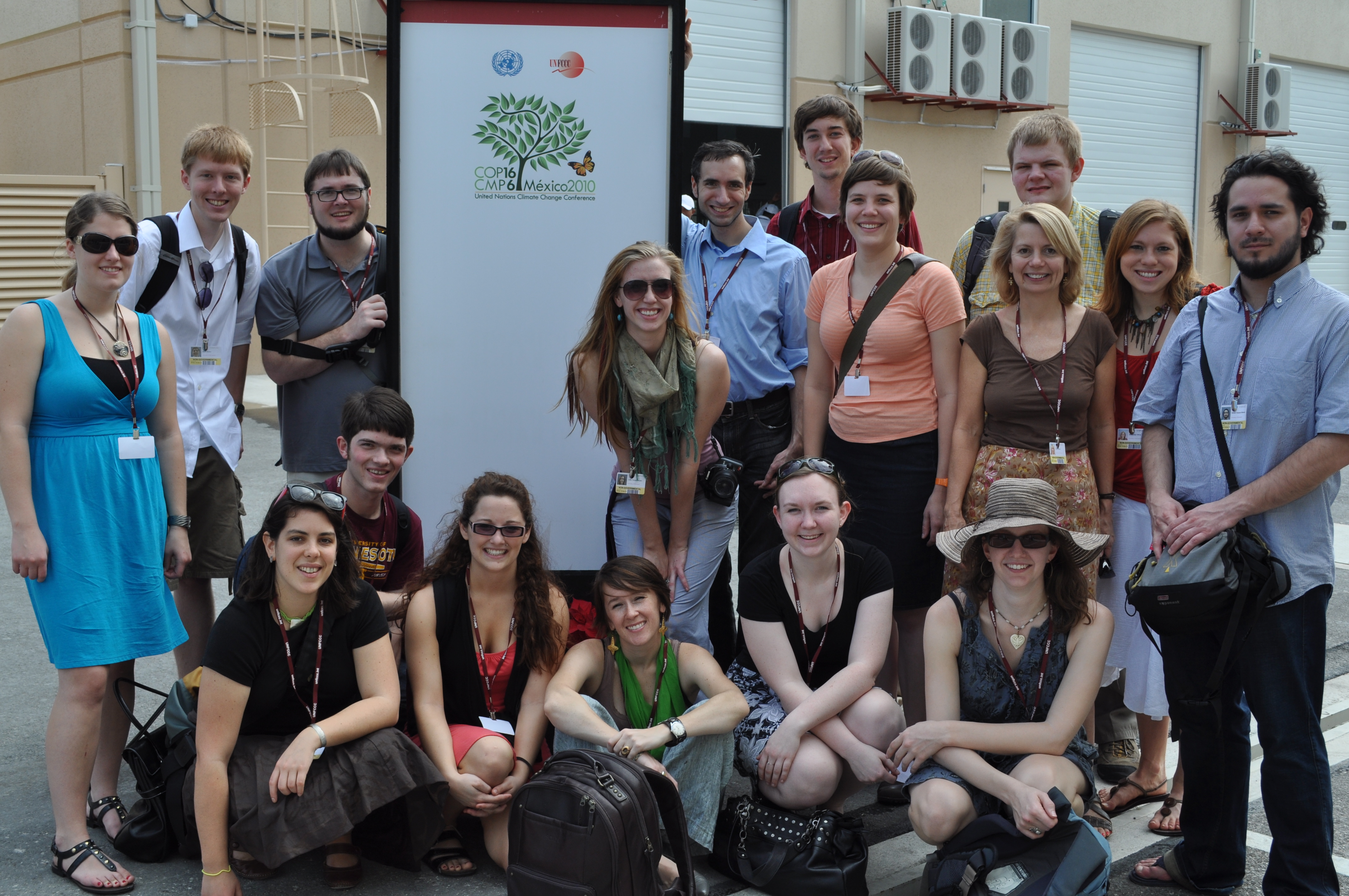
Sunday began the journey of the University of Minnesota delegation at the UNFCCC COP 16. Our group consists of a diverse group of undergraduate and graduate students of a range of interests including law, ecology, political science, and civil engineering. We are led by Minnesota Senator Ellen Anderson and Representative Kate Knuth. Our delegation will be observing official UN negotiations and events and reporting back to Minnesota on the importance of the negotiations.
Just a bit of background:
COP 16 (Conference of the Parties 16) is being held in Cancun, Mexico at the Cancunmesse Convention Center, with an estimated attendance of 15,000-20,000 people. Attendees include official country delegates, the media, and non-governmental organizations (which is where our delegation falls). The Convention, established in 1994, holds yearly meetings to negotiate future climate change issues internationally, with a focus on adaptation, mitigation, technology transfer, finance mechanisms, and forest and land use.
The COP 15 in Copenhagen resulted in the Copenhagen Accord, which was a disappointment to many because it lacked binding greenhouse gas (GHG) emissions reductions targets to extend the Kyoto Protocol; however, it did establish financing mechanisms for developing countries to adapt to climate change. This is an important step because developed countries are acknowledging the need to assist developing countries curb their GHG emissions by financing clean development mechanisms. The US put forth a large amount of funding; hopefully this means that the US will be willing to step up on this issue in Cancun and beyond.
The meeting in Cancun is not projected to create binding international targets; however, important steps are expected to be taken to smooth out issues between parties, with an expected binding agreement that extends Kyoto’s agreements at COP 17.
Many of the disagreements are between developed and developing countries. A large negotiating block involves the BASIC countries (Brazil, South Africa, India, and China) who are concerned with the impacts of reducing GHG emissions on economic growth. These countries are worried that they will not be able to grow as easily and successfully with restrictions on GHG emissions. This is an issue of equity: if America and Europe were able to develop while emitting enormous amounts of GHG emission, shouldn’t these countries be able to do the same? Or should they be helped financially by the developed countries to grow greener? It will be interesting to witness how the UN process deals with these questions of equity first-hand; I will try to keep you updated on the tone and results of the negotiations I witness.
Throughout the Conference, our delegation will be meeting with groups and organizations from around the world to understand the global perspective of climate change. On Sunday night, our group met up with the New Zealand Youth Delegation, also known as the “Kiwis.” The group’s energy and excitement was incredible! As a youth delegate, I sometimes feel that I may not be able to make the desired changes and impacts I want to, but the New Zealander’s really inspired a ‘yes you can’ view. They were dedicated to make positive changes and I was excited that their group and hundreds of other youth were working diligently on this issue. I am looking forward to keeping in touch with the Kiwis and meeting new friends as the Conference officially begins today!
For more information on COP 16, visit http://unfccc.int/2860.php.
For more information on the Kyoto Protocol see http://unfccc.int/kyoto_protocol/items/2830.php.
For additional information on the projected impacts of climate change specifically in the Midwest, see the report by the US Global Climate Change Research Program at http://downloads.globalchange.gov/usimpacts/pdfs/climate-impacts-report.pdf.
| State Senator Ellen Anderson, Representative Kate Knuth and a delegation of University of Minnesota students are attending the COP 16 conference in Cancun, and students will share the experience with TC Daily Planet readers through blog post from the conference. |
Comment